In March 2026, Physical AI is meeting Friend-shoring 2.0. Discover how autonomous robotics are enabling a new era of regional manufacturing resilience and trust-based supply chains.
Beyond Relocation: The Dawn of Friend-shoring 2.0
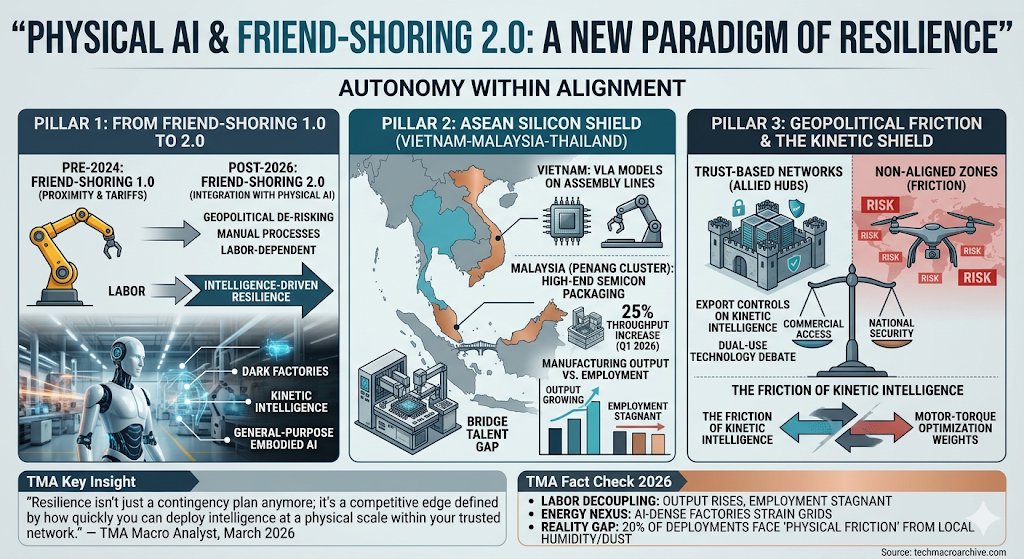
By Q1 2026, “Friend-shoring” has outgrown its original definition. It is no longer just about moving factories to friendly nations to avoid tariffs. We have entered Friend-shoring 2.0, a paradigm where the relocation of production is inseparable from the deployment of Physical AI.
In this new era, the goal isn’t just “proximity” but “Autonomy within Alignment.” High-value production lines are being re-established in allied hubs like Vietnam and Malaysia, but they are being built as “Dark Factories”—highly automated environments where Physical AI agents manage everything from precision assembly to predictive maintenance. This allows Western and Korean firms to maintain high productivity without being tethered to the labor market volatility or the geopolitical risks of the 2010s.
The ASEAN Silicon Shield: A Kinetic Frontline
The “ASEAN Silicon Shield” (the Vietnam-Malaysia-Thailand corridor) has become the primary laboratory for this convergence.
- Vietnam recently broke ground on its first domestic 32nm fabrication plant via Viettel Group, but the real story is the integration of Vision-Language-Action (VLA) models on the assembly lines.
- Malaysia’s Penang cluster has seen a 25% increase in throughput this quarter. This wasn’t achieved by hiring more workers—Malaysia is currently facing a chronic engineer shortage—but by deploying Kinetic Intelligence that can navigate the messy, physical reality of high-end semiconductor packaging.
This is the ultimate macro-hedge: using Physical AI to bridge the “Talent Gap” in friend-shored regions.
The Friction of Kinetic Intelligence
However, this convergence is creating a new category of Geopolitical Friction. As of March 2026, the US and the EU are engaged in intense debate over the export controls of “Kinetic Intelligence.”
If a robot can learn to build a semiconductor in Hanoi, can it be taught to build a drone in a non-aligned zone? The 2026 Trump Administration is increasingly viewing high-end robotics software not as a commercial product, but as a dual-use weapon. We are moving toward a world where “Trust” is measured by who is allowed to download the latest motor-torque optimization weights.
“Resilience isn’t just a contingency plan anymore; it’s a competitive edge defined by how quickly you can deploy intelligence at a physical scale within your trusted network.” — TMA Macro Analyst, March 2026.
TMA Fact Check 2026
- The Labor Decoupling: In the 2026 “ASEAN Growth Triangle,” manufacturing output is growing at 9% YoY, while manufacturing employment is stagnant, proving that Friend-shoring 2.0 is fundamentally an automation play.
- The Energy Nexus: These AI-dense factories are putting immense strain on regional grids. Vietnam’s move toward SMR (Small Modular Reactor) integration, as discussed in our [Nuclear AI Renaissance] report, is the only long-term path to sustaining this physical breakout.
- The Reality Gap: While “Sim-to-Real” training has improved, 20% of robotics deployments in new friend-shored sites still face “Physical Friction”—breakdowns caused by local humidity and dust that synthetic training environments failed to predict.
Related Deep Analysis
- [The Physical AI Breakout: Why 2026 is the Year Robotics Learned to “Feel”]
- [The Silicon Shield of Southeast Asia: Vietnam and Malaysia’s 2026 Power Move]
- [The Nuclear AI Renaissance: SMRs as the Ultimate Data Center Hedge]
The Sharp Question
As we move our factories to friendly shores and staff them with Physical AI, are we actually building a more resilient world—or are we simply creating a high-tech “Silicon Curtain” that leaves non-aligned nations further behind in the dust of the 20th century?
#Physical AI #Friend-shoring 2.0 #Supply Chain 2026 #Robotics #Vietnam #Malaysia #Geopolitics