In March 2026, Physical AI is driving a global GDP surge. Explore how VLA models and humanoid robotics are transforming blue-collar productivity and infrastructure demand.
The 2.8% Sturdy Growth: Driven by Atoms, Not Just Bits
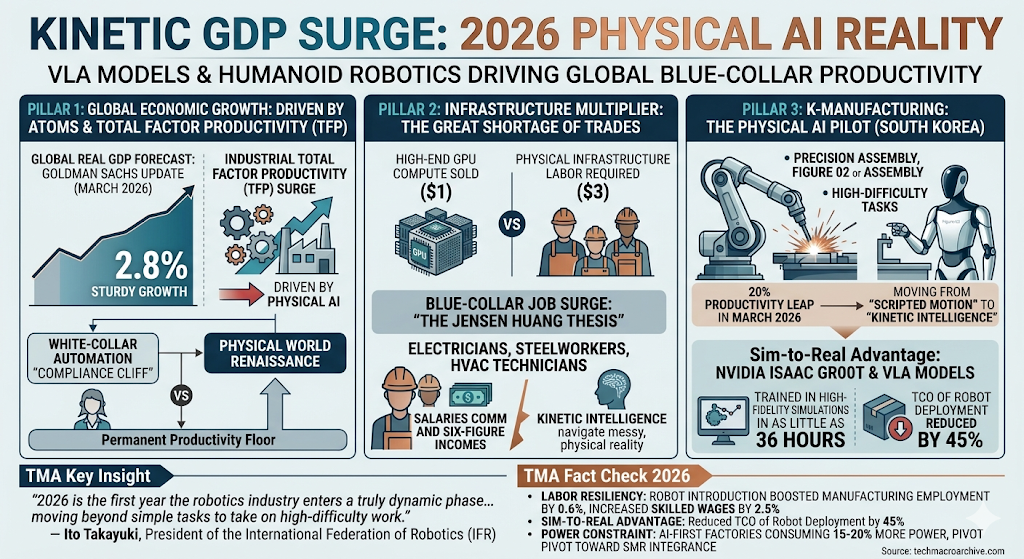
By March 2026, the global economic narrative has taken a surprising turn. While white-collar automation faces a “compliance cliff,” the physical world is experiencing a renaissance. Goldman Sachs recently updated its global real GDP forecast to 2.8%, outperforming consensus. The primary engine? A surge in industrial Total Factor Productivity (TFP) driven by Physical AI.
We are seeing the first signs of a “Permanent Productivity Floor.” In the U.S., the “One Big Beautiful Bill Act” tax cuts have funneled capital into AI infrastructure, but it is the deployment of autonomous systems in logistics and manufacturing that is sustaining the rally. The IMF notes that while 40% of jobs are “exposed” to AI, in advanced economies, the productivity boost in trades is outweighing the displacement of routine labor.
The Jensen Huang Thesis: The Tradecraft Surge
NVIDIA CEO Jensen Huang’s January 2026 prediction is now a market reality: the AI boom is a Blue-Collar Job Surge. Building the power-dense data centers and chip fabs required for the next generation of Blackwell-class clusters has created a “Great Shortage” of electricians, steelworkers, and HVAC technicians.
In some hubs, salaries for these trades have nearly doubled, with workers commanding six-figure incomes. This is the Infrastructure Multiplier: for every dollar of high-end GPU compute sold, approximately $3 of physical infrastructure labor is required to house and power it.
K-Manufacturing: The Physical AI Pilot
The most aggressive adoption is visible in South Korea’s “K-Manufacturing” sector. In March 2026, major shipbuilders and automotive giants like Hyundai and Samsung have reported a 20% productivity leap in high-difficulty tasks like welding and precision assembly.
This is the first year robots moved from “Scripted Motion” to “Kinetic Intelligence.” Using Vision-Language-Action (VLA) models, robots can now be “trained” via high-fidelity simulations in as little as 36 hours. This solves the chronicSim-to-Real gap, allowing humanoids like Tesla’s Optimus Gen 3 and Figure 02 to operate in unstructured environments that were previously too complex for traditional automation.
“2026 is the first year the robotics industry enters a truly dynamic phase… moving beyond simple tasks to take on high-difficulty work.” — Ito Takayuki, President of the International Federation of Robotics (IFR).
TMA Fact Check 2026
- The Labor Resiliency: Contrary to “robot apocalypse” fears, the Korea Labor Institute found that robot introduction actually boosted manufacturing employment by 0.6% and increased skilled wages by 2.5% as workers transitioned to “Robot Managers.”
- The Sim-to-Real Advantage: Synthetic data generation through platforms like NVIDIA Isaac GR00T has reduced the TCO of robot deployment by 45%, making Physical AI accessible to mid-market manufacturers for the first time.
- The Power Constraint: The only ceiling on this kinetic GDP surge is energy. AI-first factories are consuming 15-20% more power than traditional ones, forcing a pivot toward SMR integration as discussed in our [Nuclear AI Renaissance] report.
Related Deep Analysis
- [The Physical AI Breakout: Why 2026 is the Year Robotics Learned to “Feel”]
- [The Convergence of Physical AI and Friend-shoring 2.0: Rewiring the Global Factory]
- [The Nuclear AI Renaissance: SMRs as the Ultimate Data Center Hedge]
The Sharp Question
As Physical AI bridges the labor gap and fuels a $2.9 trillion economic value surge, we face a new class divide: will the wealth generated by “Kinetic GDP” be distributed to the tradespeople who build it, or will it be swallowed by the hyperscalers who own the “VLA Brains” controlling the machines?
#Physical AI #GDP 2026 #Blue Collar Productivity #NVIDIA #Humanoid Robots #K-Manufacturing #Tech Macro