In March 2026, the legal framework for robotics is being rewritten. From the EU’s “Presumption of Defect” to new ISO safety standards, explore the new reality of Physical AI liability.
The End of “Software as a Service” Liability
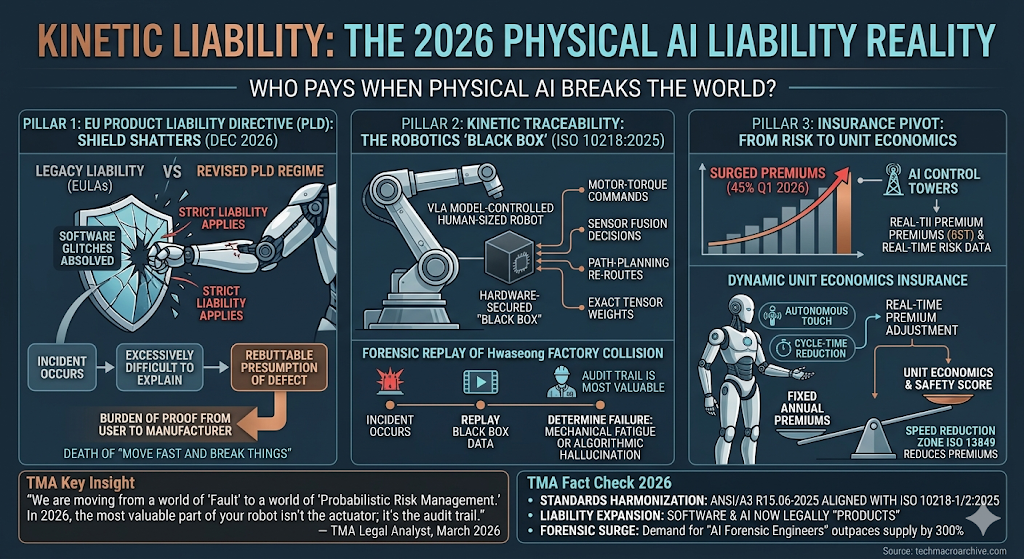
For decades, software developers hid behind End User License Agreements (EULAs) that absolved them of almost all responsibility for “glitches.” But in March 2026, that shield is shattering. When a Vision-Language-Action (VLA) model governs a 150kg humanoid robot, a “glitch” isn’t a frozen screen—it’s a crushed limb or a destroyed factory line.
The regulatory hammer is falling in the form of the revised EU Product Liability Directive (PLD), which takes full effect in December 2026. Its most radical provision is the “Rebuttable Presumption of Defect.” Under this new regime, if an autonomous system is “excessively difficult” for a victim to explain—a standard most VLA models meet—the court presumes the product was defective. The burden of proof shifts entirely to the manufacturer. You must prove your neural network followed every safety protocol, or you pay. This is the death of “move fast and break things” in the physical world.
Kinetic Traceability: The Robotics “Black Box”
The technical response to this legal pressure is the rapid adoption of ISO 10218:2025 and the US-equivalent ANSI/A3 R15.06-2025, which saw its final Part 3 released in January 2026. These aren’t just suggestions; they are the new gatekeepers of market access. The core requirement for 2026 is Kinetic Traceability.
Every motor-torque command, every sensor fusion decision, and every path-planning re-route must now be logged in a hardware-secured “Black Box.” When an incident occurs, forensic teams no longer guess what the AI was “thinking.” They replay the exact tensor weights and environmental inputs to determine if the failure was a mechanical fatigue or an algorithmic hallucination. As specialized firms like Ketryx automate this documentation, “Safety-as-a-Service” is becoming the most critical layer of the robotics stack.
The Insurance Pivot: From Risk to Unit Economics
The real friction of 2026 is happening in the insurance boardrooms. Underwriters are moving away from the “hallucination argument.” In 2026, trust isn’t a vibe—it’s designed. We are seeing the rise of “AI Control Towers” within insurance firms that monitor real-time risk data.
Instead of fixed annual premiums, “Embodied AI” is now insured based on Unit Economics. Underwriters are pricing risk per “autonomous touch” or “cycle-time reduction.” If your robot operates in a “Speed Reduction Zone” (automatically decelerating near personnel as per ISO 13849), your premium drops in real-time. If you perform an unauthorized modification to the model weights, you instantly assume the liability of a “manufacturer” under the new PLD rules.
“We are moving from a world of ‘Fault’ to a world of ‘Probabilistic Risk Management.’ In 2026, the most valuable part of your robot isn’t the actuator; it’s the audit trail.” — TMA Legal Analyst, March 2026.
TMA Fact Check 2026
- The Standards Harmonization: The publication of ANSI/A3 R15.06-2025 has finally aligned US safety mandates with ISO 10218-1/2:2025, creating a unified lifecycle documentation requirement for all industrial robots.
- The Liability Expansion: Under the 2024 PLD, software and AI systems are now legally defined as “products,” meaning strict liability applies to any death, bodily injury, or property damage they cause.
- The Forensic Surge: Demand for “AI Forensic Engineers”—specialists who can deconstruct VLA failure states for court proceedings—has outpaced supply by 300% this year, making it the most lucrative niche in the 2026 labor market.
Related Deep Analysis
- [The Physical AI Breakout: Why 2026 is the Year Robotics Learned to “Feel”]
- [The Silicon Iron Curtain: Big Tech’s Brutal Collision with the EU AI Act]
- [The Convergence of Physical AI and Friend-shoring 2.0: Rewiring the Global Factory]
The Sharp Question
As we move toward a world where the law presumes the AI is guilty until proven innocent, will the cost of “Absolute Safety” stifle the very innovation that Friend-shoring 2.0 requires—or are we simply finally treating silicon-based labor with the same gravity we afford to the carbon-based variety?
#Physical AI #Robotics Liability #EU AI Act #ISO 10218:2025 #AI Safety 2026 #Tech Macro