In March 2026, the global tech landscape is splitting. Explore the rise of Tech-Neutral Nations like Singapore and the UAE, serving as the “Digital Switzerland” for a fragmented world.
The “Digital Switzerland” Strategy
By March 2026, the concept of “picking a side” has become a luxury that most middle powers can no longer afford. We are seeing the rise of a Third Block of tech-neutral nations. Countries like Singapore, the UAE, Switzerland, and Indonesia are actively positioning themselves as “Geopolitical Shock Absorbers.”
Unlike the non-aligned movement of the 20th century, this isn’t about political ideology; it’s about Dual-Stack Infrastructure. These nations are building data centers and chip fabs that can house both Western (NVIDIA/Intel) and Eastern (Huawei/Biren) hardware stacks. This “Tech-Neutrality” allows them to serve as a neutral clearinghouse for global data, essentially becoming the Digital Switzerland of the AI era.
Sovereign AI and Supply-Centric Pragmatism
The catalyst for this shift in early 2026 was the Hormuz Energy Shock. As energy prices tripled and supply chains for critical minerals fractured, even the most loyal allies of the US and China began to pivot toward Supply-Centric Pragmatism.
The narrative has shifted from “Security Alliances” to “Sovereign AI.” Nations are realizing that true independence in 2026 means owning your own algorithmic destiny. By hosting their own LLMs and NPU farms—unfettered by the export controls of Washington or the firewall mandates of Beijing—these neutral zones are attracting multinational corporations desperate to escape the “Silicon Iron Curtain.”
The Regulatory Haven: Data Sovereignty as a Product
The competitive edge of tech-neutral nations lies in their Regulatory Sovereignty. In these zones, data laws are being rewritten to offer a unique trade-off:
- Mandatory Algorithmic Transparency: To prevent foreign interference.
- Strict Prohibition of Geopolitical Data-Sharing: To protect corporate IP from state-level espionage.
This creates a haven where a US-based pharmaceutical company can collaborate with a Chinese biotech firm in a UAE-based “Clean Room,” using neutral compute power without triggering the export-control landmines that would explode in London or Shanghai.
“In 2026, neutrality is not a lack of action; it is a high-stakes infrastructure play. The nations that can bridge the algorithmic divide will be the ones that own the next decade of growth.” — TMA Geopolitical Analyst, March 2026.
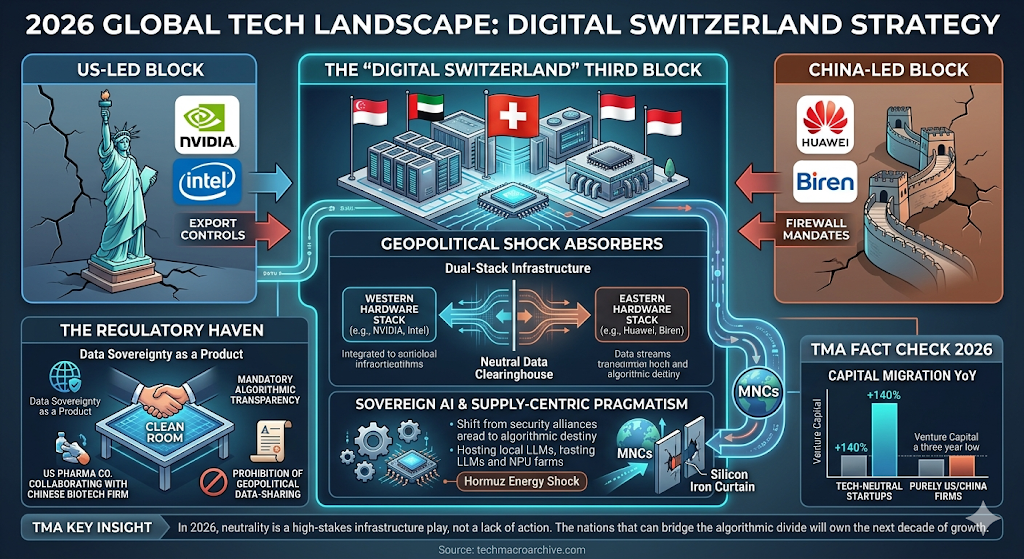
TMA Fact Check 2026
- The Dual-Stack Reality: Singapore’s newest “Neutral-Zone” data centers are currently split 55/45 between Western-made H200 clusters and Chinese-designed Ascend 920 clusters, providing a literal physical bridge for global inference tasks.
- The Capital Migration: Venture capital flows into “Tech-Neutral” startups (firms registered in neutral zones with diversified hardware supply chains) have increased by 140% YoY, while investment in purely US or China-centric firms has hit a three-year low.
- The Compliance Arbitrage: Legal firms specializing in “Jurisdictional Arbitrage”—helping companies re-domicile their AI weights to neutral zones—are reporting a backlog of clients through H2 2026.
Related Deep Analysis
- [The Silicon Iron Curtain: Big Tech’s Brutal Collision with the EU AI Act]
- [The Convergence of Physical AI and Friend-shoring 2.0: Rewiring the Global Factory]
- [The $700 Billion Sprint: Is Big Tech’s AI CAPEX Hitting a Terminal Peak?]
The Sharp Question
As the world fractures into two incompatible technological regimes, can the Tech-Neutral Nations truly remain “un-aligned,” or are they simply building a more sophisticated waiting room for a conflict that will eventually demand they choose a side?
#Tech Neutrality #Geopolitics 2026 #Sovereign AI #Singapore #UAE #Supply Chain Resilience #Tech Macro