The spring sunlight pouring through the windows of my Nusan-ri studio is blindingly bright. The late-season cold snap that gripped the Han River for days has finally retreated, leaving behind silver scales of light dancing on the water and a deceptive warmth in the air. But as I pivot back to my monitors, the geopolitical data streaming across the glass remains bone-chillingly cold.
Leaning against the dark wood of my desk, I watch a lone crane on the horizon—a silent sentinel amidst the restless, skeletal expansion of the Gimpo skyline. The espresso in my mug is as dark and unforgiving as the strategic map I am currently deconstructing. We speak of “digital transformation” as if it were a weightless, ethereal shift in logic.
Explore the 2026 semiconductor landscape in Southeast Asia. From Vietnam’s first domestic fab to Malaysia’s IC design pivot, discover how the region is becoming a critical node in the global AI supply chain.
Vietnam’s Leap: From Assembly to Fabrication
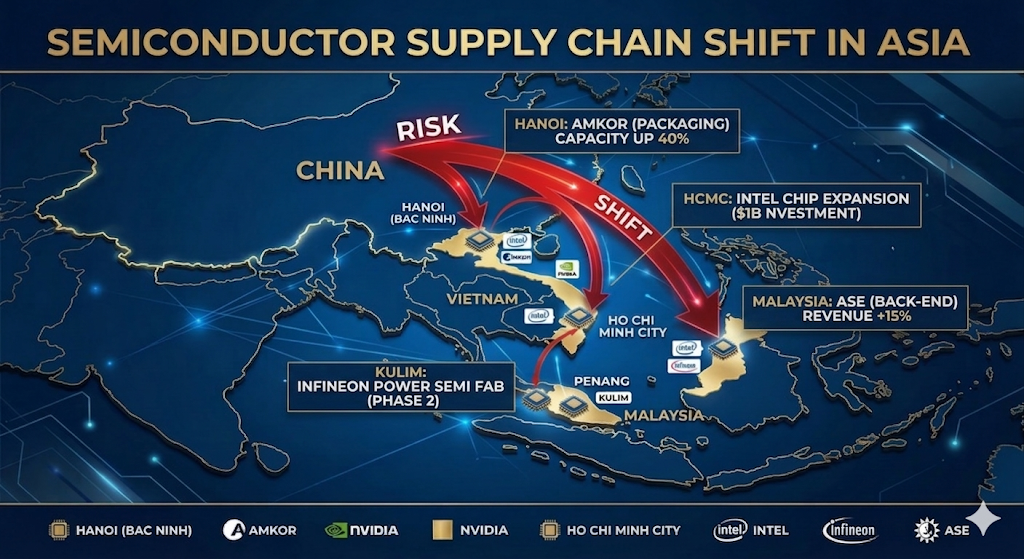
By March 2026, Vietnam has moved past the status of a “low-cost alternative.” The groundbreaking of Viettel’s first semiconductor fabrication plant in Hanoi marks a decisive shift into front-end manufacturing. This isn’t just about domestic pride; it’s about Algorithmic Sovereignty.
Vietnam is leveraging its robust electronics base—which saw hardware exports exceed $132 billion last year—to climb the value chain. With global giants like Amkor and Samsung already anchoring the packaging and testing sector, the move into wafer fabrication is a high-stakes bet that Hanoi can handle the “Technological Complexity” of the front-end, targeting priority sectors like aerospace and automotive manufacturing.
Malaysia: The OSAT Giant Reinvents Itself
Malaysia, the world’s sixth-largest semiconductor exporter, is no longer content with its traditional 13% global share in Outsourced Semiconductor Assembly and Test (OSAT). The National Semiconductor Strategy (NSS) and Budget 2026 have set an aggressive course to transform Penang from “Made in Penang” to “Designed by Malaysia.”
The focus has shifted to Advanced Packaging and IC Design. The “Penang Silicon Design @5KM+” initiative is creating a hyper-concentrated R&D cluster designed to attract major buyers like Apple and NVIDIA. As we hit H1 2026, the strategy is working: specialized IC design parks are popping up across the state, fueled by subsidies and a mature ecosystem that has spent 50 years preparing for this moment of Geopolitical Friction.
“Southeast Asia is no longer just a cost-competitive manufacturing base; rather, it is actively repositioning as a hub for high-value production… semiconductors and industrial AI are driving this new demand.” — AMT International Report, March 2026.
The ASEAN Growth Triangle: Complementarity vs. Competition
What the critics miss is the emerging “Growth Triangle” between Vietnam, Malaysia, and Thailand. Rather than a zero-sum game, we are seeing a “Regional Specialization” model:
- Singapore leads in advanced R&D and upstream design.
- Malaysia dominates sophisticated packaging and inspection systems.
- Vietnam drives cost-efficient assembly and increasingly, domestic fabrication.
This synergy is the region’s ultimate “Silicon Shield” against the volatility of US-China trade policies. By integrating their supply chains, ASEAN nations are making themselves indispensable to a global AI infrastructure that is forecast to surpass $1.3 trillion in spending this year.
TMA Fact Check 2026
- The Talent Bottleneck: Vietnam currently has approximately 7,000 chip design engineers but needs over 50,000 by 2030. This “Talent Gap” is the single greatest threat to its fabrication ambitions, leading to a massive surge in government-led STEM initiatives.
- The Yield War in OSAT: Advanced packaging (2.5D/3D) is where the real margin lies. Malaysia is aggressively courting Taiwanese players like ASE Technology to bring high-end image sensor and AI processor packaging to its Kulim and Penang sites.
- Infrastructure Friction: While investment is flowing, energy stability remains a concern. Much like the [Nuclear AI Renaissance] we see in the West, Southeast Asian hubs are scrambling to secure stable, baseload power to prevent the brownouts that plagued 2024-2025 production cycles.
Related Deep Analysis
- [The Nuclear AI Renaissance: SMRs as the Ultimate Data Center Hedge]
- [The On-Device AI Mirage: Why Your 2026 PC Is a Local LLM Prison]
The Sharp Question
As Vietnam and Malaysia move up the value chain, they are inevitably entering the crosshairs of global trade scrutiny. Can the “ASEAN Way” of neutrality survive a world where a single chip fab in Hanoi or a design hub in Penang becomes a strategic asset in a 2026 technological cold war?
#Semiconductor Hub #Vietnam Tech #Malaysia Semiconductor #OSAT #IC Design #Geopolitical Friction #2026 Tech Macro