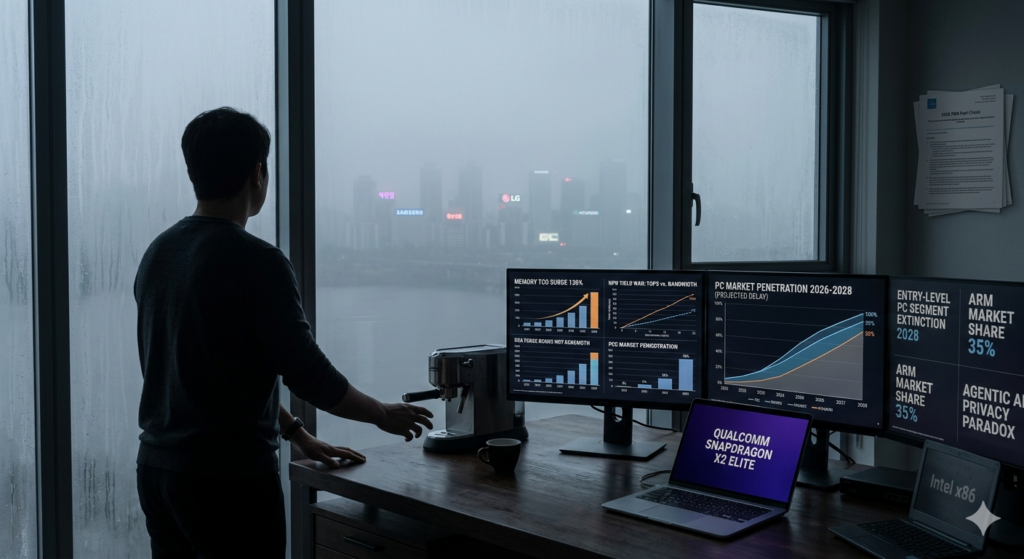
The morning mist off the Han River is particularly heavy today, a thick, gray shroud that makes the neon signs of the distant high-rises look like dying embers. I can feel the damp cold seeping through the studio window, settling into my joints. I press my palms against the cold, dark wood of my desk, steadying myself before the first sip of an espresso so bitter it matches the current macroeconomic outlook. The silence here in my Gimpo studio is expensive, but the data streaming across my monitors is even more so.
As we hit 2026, the AI PC is no longer a choice but a mandatory upgrade. However, soaring memory TCO and NPU yield wars are creating a performance gap that marketing won’t tell you about.
The NPU Yield War: TOPS as a Distraction
The industry wants you to believe that 2026 is the year of “Total Algorithmic Sovereignty.” They’ve spent billions convincing you that your laptop is now a localized powerhouse, a silicon fortress where your data stays private and your AI agents run with zero latency.
But watching the gray Han River fog swallow the landscape, I see the cracks in that narrative. We aren’t entering an era of freedom; we are entering an era of hardware-gated intelligence. Qualcomm’s Snapdragon X2 Elite is screaming about its 80 TOPS capability, effectively doubling the 40 TOPS baseline Microsoft set for Copilot+ PCs. It’s a staggering number, outperforming Intel’s Panther Lake in multi-core rendering.
However, TOPS is a hollow metric if the memory bandwidth can’t feed the beast. While the X2 Elite wins the “Yield War” in raw throughput, Apple’s M5 chip still holds the single-core crown, which remains the critical factor for the initial “token-to-thought” latency in local Small Language Models (SLMs). Contextually, as discussed in [On-Device AI: The Personal Computing Revolution (2026)], the hardware is only as good as its weakest link.”The transition from ‘The Personal Computing Revolution’ to ‘The On-Device Disappointment’ is fueled by a simple technical failure: the hardware is only as good as its weakest link. Just as NPUs struggle without massive memory bandwidth, the dream of truly portable, high-performance AI powerhouses collapses without radical energy stability. This is where [Solid-State Battery Geopolitics] dictates the new sovereign boundary of 2026.“
The Memory Tax: The Death of the Entry-Level PC
If you’re looking for a bargain AI PC in 2026, forget it. The macroeconomic friction is real. Combined DRAM and SSD prices have surged by 130% this year. This “Memory Tax” is projected to hike AI PC retail prices by at least 17%.
We are witnessing the systematic extinction of the sub-$500 laptop. By 2028, the “entry-level” segment will simply cease to exist. You are either a premium AI user, or you are a digital ghost clinging to a 2023 x86 relic.
“The sub-$500 entry-level PC segment will disappear by 2028… rising AI PC prices will delay the projected 50% market penetration.” — Ranjit Atwal, Gartner Senior Director Analyst.
TMA Fact Check 2026
- The Performance Gap: While NPU power has increased 2x year-over-year, mobile memory bandwidth (currently peaking around 90 GB/s) remains 30x slower than data center GPUs, ensuring that “Frontier” models will stay in the cloud for the foreseeable future.
- The ARM Hegemony: In the consumer sector, ARM-based AI laptops are expected to grab nearly 35% of the market this year, driven by the Snapdragon X2 series’ superior power-to-performance ratio compared to Intel’s Lunar Lake.
- The Privacy Paradox: On-device AI is marketed as a privacy win, yet “Agentic AI” (autonomous agents) requires constant telemetry for “improvement,” meaning your local data is still being harvested, just through more sophisticated metadata channels.
Related Deep Analysis
- [On-Device AI: The Personal Computing Revolution (2026)]
The Sharp Question
As hardware manufacturers phase out affordable, non-AI PCs to protect their shrinking margins, are we actually buying “Personal Intelligence,” or are we just paying a mandatory subscription fee for a silicon NPU we don’t fully control?
#On-Device AI #NPU #Snapdragon X2 Elite #Apple M5 #AI PC Market 2026 #Tech Macro