Explore the massive announcements from NVIDIA GTC 2026. From the Vera Rubin architecture and Vera CPU to the OpenClaw framework, Jensen Huang has unveiled the infrastructure for the agentic era.
The Vera Rubin Platform: A 40 Million-Fold Leap
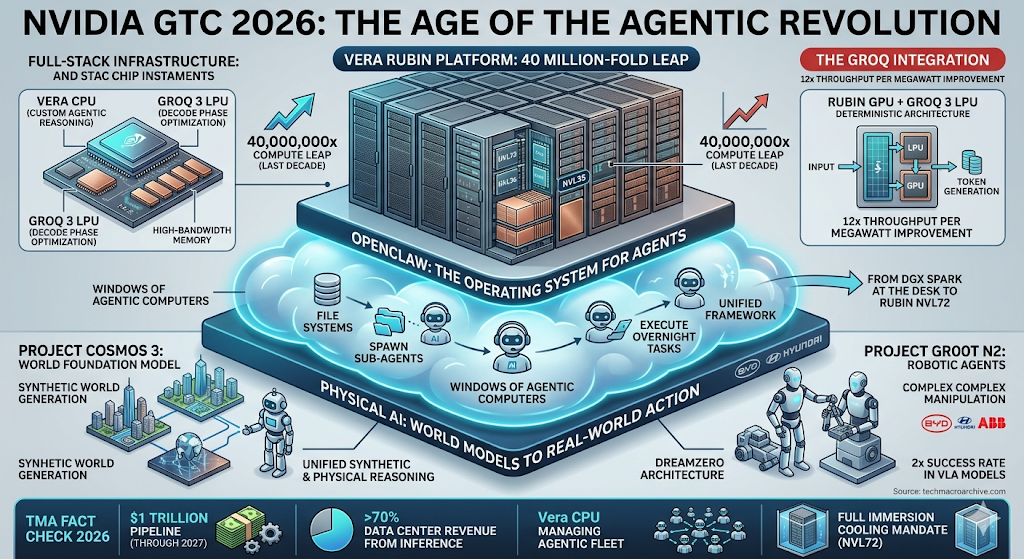
By March 2026, NVIDIA has officially transitioned from a GPU vendor to the foundational provider of “Planetary-Scale Infrastructure.” The headline of GTC 2026 is Vera Rubin—a full-stack platform comprising seven chips and five rack-scale systems. Named after the astronomer who provided evidence for dark matter, the Rubin architecture is designed to shine light on the “Inference Inflection,” where tokens are generated not by the billions, but by the quadrillions.
The performance leap is staggering. Jensen Huang claimed the Rubin platform represents a 40 million times increase in compute over the last decade. Crucially, it introduces the Vera CPU, NVIDIA’s custom silicon designed to manage the high-speed sequential reasoning required for [Autonomous Digital Workers]. This marks the end of general-purpose x86 dominance in the AI factory; if you want to run an agentic fleet, you need a CPU that speaks the language of the agent.
OpenClaw: The Operating System for Agents
Hardware without a standard is just expensive sand. That’s why the launch of OpenClaw is arguably the most significant software event of 2026. Jensen described OpenClaw as the “Windows of Agentic Computers.” Just as Windows gave personal computers a standard environment to run software, OpenClaw provides a unified framework for AI agents to navigate file systems, spawn sub-agents, and execute overnight tasks without human supervision. By supporting OpenClaw across its entire stack—from DGX Spark at the desk to the Rubin NVL72 rack in the data center—NVIDIA is ensuring that the “Agentic Revolution” remains tethered to its proprietary networking and compute fabric.
The Groq Integration: Solving the Decode Bottleneck
One of the sharpest moves at GTC was the debut of the NVIDIA Groq 3 LPU (Language Processing Unit). Following the $20 billion acquisition of Groq in late 2025, NVIDIA has integrated this deterministic, low-latency architecture directly into its Vera Rubin reference designs.
The Groq 3 LPU is specifically optimized for the “decode phase” of the inference lifecycle, where token generation speed often hits a wall. By pairing the brute-force throughput of Rubin GPUs with the surgical latency of Groq LPUs, NVIDIA is targeting a 12x improvement in through-put per megawatt, effectively silencing critics who argued that AI energy costs would hit a [Terminal Peak] in 2026.
Physical AI: From World Models to Real-World Action
NVIDIA’s “Physical AI” ambitions have matured into Project GR00T N2 and Cosmos 3.
- Cosmos 3 is the industry’s first “World Foundation Model” that unifies synthetic world generation with physical reasoning.
- GR00T N2, built on the DreamZero architecture, allows robots to perceive and act in the real world with twice the success rate of previous VLA models.
The goal is clear: to make every industrial company a robotics company. With partners like BYD, Hyundai, and ABB already integrating these models, the boundary between the digital agent and the physical machine is dissolving into a single, NVIDIA-powered continuum.
“Every single company in the world today has to have an OpenClaw strategy. This is the new computing layer.” — Jensen Huang, NVIDIA CEO, GTC 2026.
TMA Fact Check 2026
- The $1 Trillion Pipeline: NVIDIA’s purchase order pipeline for Blackwell and Vera Rubin systems through 2027 has officially hit $1 trillion, doubling the projections from just 12 months ago.
- The Inference Dominance: For the first time, over 70% of NVIDIA’s data center revenue is projected to come from inference rather than training, signaling that the “Generative Era” has moved into the “Execution Era.”
- The Cooling Mandate: The Vera Rubin NVL72 rack requires full Immersion Cooling or high-flow direct-to-chip liquid loops, reinforcing the “Thermal Wall” we identified in the [Submerged Edge] report.
Related Deep Analysis
- [The Death of the Assistant: Why 2026 is the Year of the Autonomous Digital Worker]
- [The $700 Billion Sprint: Is Big Tech’s AI CAPEX Hitting a Terminal Peak?]
- [The Submerged Edge: Why Immersion Cooling is the Silent Pulse of 2026 AI]
The Sharp Question
As NVIDIA builds the chips, the racks, the OS, and the world models, they are effectively becoming the sovereign architect of the global economy. In a world where every “Digital Worker” runs on an NVIDIA stack, what happens to the concept of competitive differentiation when the “Operating System” of your business is owned by a single silicon giant?
#NVIDIA GTC 2026 #Vera Rubin #Vera CPU #OpenClaw #Agentic AI #Physical AI #Blackwell Ultra