“The March fog, drifting in from the Han River, has finally seeped through the window seals, transforming my Gimpo studio into a cold, damp vault. I sit here, eyes fixed on the monitors before me. The aluminum chassis of my laptop feels like an ice pack against my palms. In this business, if you aren’t feeling the chill of the macro shift, you are already irrelevant.
Let’s stop pretending the ‘China-plus-one’ strategy is merely one of many choices. In 2026, it is no longer a strategic option; it is a desperate scramble for survival.”
As the decoupling from China accelerates in 2026, India and Vietnam emerge as the new battlegrounds for semiconductor OSAT and advanced packaging.
The Death of the Seamless Supply Chain
The romanticized notion of a globalized, borderless supply chain has been unceremoniously buried. In its place stands a fragmented, paranoid landscape defined by Geopolitical Friction and the desperate need for Algorithmic Sovereignty. As we move through 2026, the most violent tremors aren’t occurring in front-end wafer fabrication, but in the once-overlooked “back-end”—the Outsourced Semiconductor Assembly and Test (OSAT) sector.
For decades, China was the world’s back-end factory. No longer. The “China Plus One” strategy has evolved from a cautious backup plan into a mandatory survival tactic for any firm wishing to remain in the graces of the global market.
The Duel: New Delhi’s Ambition vs. Hanoi’s Infrastructure
India and Vietnam are currently locked in a high-stakes Yield War, each vying to become the definitive alternative to the Pearl River Delta.
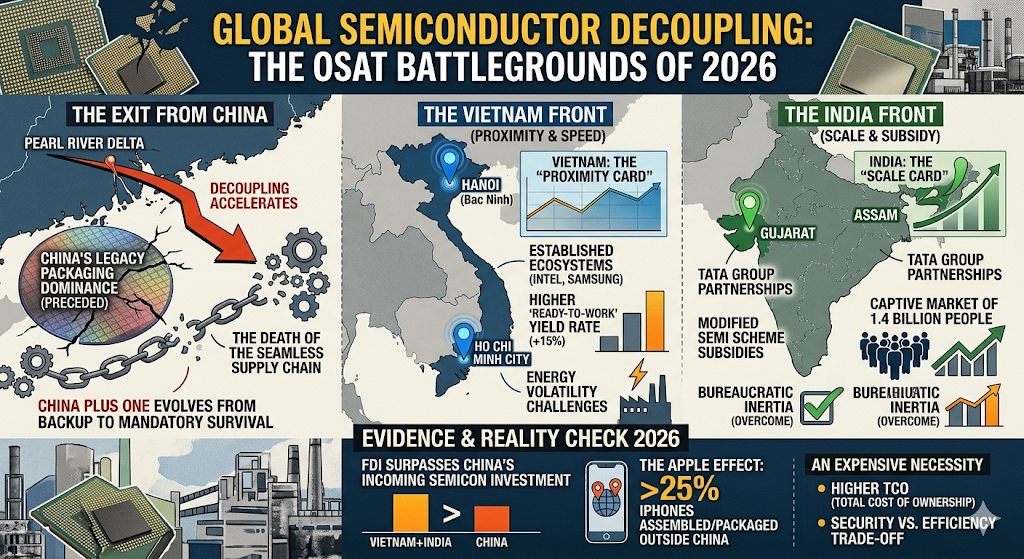
India has finally moved past the bureaucratic inertia that plagued its initial semiconductor forays. By 2026, the Tata Group’s partnership with PSMC and the massive subsidies under the Modified SEMI scheme have turned Gujarat and Assam into credible packaging contenders. New Delhi isn’t just offering land; they are offering a captive market of 1.4 billion people—a leverage point Vietnam simply cannot match.
Vietnam, conversely, plays the “Proximity Card.” Its geographic closeness to the existing tech ecosystems of Shenzhen and Taiwan remains its greatest asset. Samsung and Intel have already laid the groundwork in Bac Ninh and Ho Chi Minh City. Vietnam’s advantage lies in its specialized labor pool and established logistics, though it struggles with the same energy volatility that haunted its manufacturing sector in previous years.
Evidence & Reality Check
“The shift of advanced packaging to South and Southeast Asia is no longer about cost-cutting. It is about de-risking the entire Western compute stack from the whims of a single geopolitical actor.” — Excerpt from 2026 TMA Macro Report.
TMA Fact Check 2026:
- Investment Parity: As of Q1 2026, combined FDI into Vietnam and India’s semiconductor sectors has surpassed China’s incoming semiconductor manufacturing investment for the fourth consecutive quarter.
- The Apple Effect: Over 25% of all iPhones are now assembled and partially “packaged” outside of China, a feat thought impossible just three years ago.
- The Talent Gap: While India has the scale, Vietnam currently holds a 15% higher “Ready-to-Work” yield rate for advanced packaging technicians compared to the nascent Indian clusters.
Let’s be clear: this isn’t a “win” for global trade. It is an expensive necessity. Moving packaging hubs to India or Vietnam involves massive TCO (Total Cost of Ownership) increases that will eventually be passed down to the consumer. We are trading the efficiency of the Chinese machine for the security of a fragmented one.
For Korean firms like SK Hynix and Samsung, the choice isn’t “if” they diversify their back-end, but how quickly they can do so without tanking their margins. The “China Exit” is a one-way door. Once you walk through it, you are at the mercy of the host nation’s power grid and political stability.
Related Deep Analysis
- The Post-China Silicon Shield
- Next-Gen Data Centers and the SMR Integration
- Algorithmic Sovereignty and the Death of Global Standards
The Sharp Question
As the packaging war intensifies, will India’s massive domestic market be enough to offset its infrastructure “teething” pains, or will Vietnam’s proximity to the old guard keep it in the lead for the rest of the decade?
#Semiconductor Supply Chain #Geopolitics #India Tech #Vietnam Manufacturing #OSAT #Advanced Packaging #TCO #Apple Supply Chain