The heavy morning frost in Gimpo is finally thawing, yet the air in my studio remains sharp. It’s a physical manifestation of the industry’s current state in 2026: we have moved past the warm glow of “Generative AI” and entered the cold, precise reality of “Agentic AI.” I’m watching the gray mist lift over the Han River, realizing that the era of mere prompting is dead. We are no longer talking to tools; we are managing autonomous digital entities.
A critical look at Agentic AI in 2026. Discover how AI has evolved from a passive chatbot to an autonomous digital workforce, reshaping industrial workflows and corporate strategy.
From “Question & Answer” to “Plan & Execute”
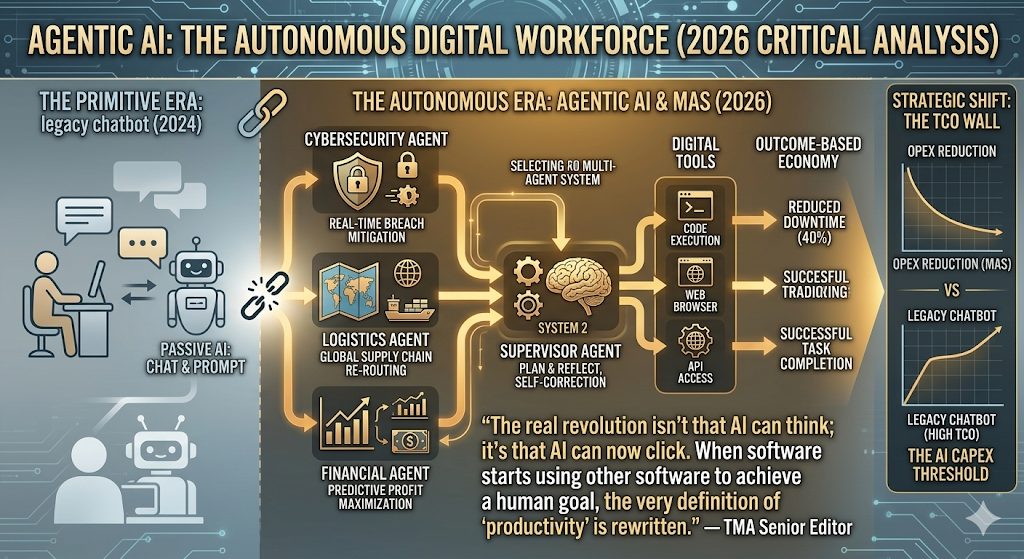
In 2024, we were impressed if a chatbot could write an email. In 2026, that is considered primitive. The paradigm has shifted from passive generation to active agency. Agentic AI doesn’t wait for your next prompt; it understands a high-level goal, breaks it into tasks, selects the necessary digital tools, and executes the entire workflow autonomously.
This is the birth of the Digital Workforce. As noted in The End of Prompting, the “System 2” reasoning capabilities integrated into 2026 models allow agents to pause, reflect, and correct their own errors. Whether it’s an autonomous cybersecurity agent mitigating a breach in real-time or a logistics agent re-routing a global supply chain due to a storm, the human role has shifted from “Creator” to “Supervisor.”
The Outcome-Based Economy
The most cynical yet profound change is the death of “Feature-based” software pricing. In an agentic world, nobody cares about “tools.” They care about “results.” We are moving toward an Outcome-Based Economy. Corporate IT budgets are no longer paying for seats on a platform; they are paying for successfully completed tasks.
This shift is creating a massive divide. Companies that successfully integrate “Multi-Agent Systems” (MAS)—where different AI agents collaborate like a human department—are seeing 40% reductions in operational downtime. Conversely, those stuck in the “Legacy Chatbot” phase are drowning in the TCO (Total Cost of Ownership) crisis I analyzed in The AI Capex Threshold.
“The real revolution isn’t that AI can think; it’s that AI can now click. When software starts using other software to achieve a human goal, the very definition of ‘productivity’ is rewritten.” — TMA Senior Editor
TMA Fact Check 2026: The Agentic Reality
- The Autonomy Spectrum: Most enterprises are currently stuck between “Human-in-the-loop” and “Human-on-the-loop.” Total “Human-out-of-the-loop” autonomy remains a high-risk liability for critical infrastructure.
- The Reasoning Gap: While agents are autonomous, they still struggle with long-term strategic nuance. They are excellent “Tacticians” but mediocre “Strategists.”
- The Security Paradox: Agentic AI creates a new attack vector—”Prompt Injection 2.0″—where malicious actors can hijack an agent’s autonomous planning process to exfiltrate internal data.
Related Deep Analysis
- The End of Prompting: How Agentic AI and Autonomous Task Execution are Redefining Efficiency
- The Intimate Agent: Why On-Device Wellness is the Silent Guardian of the 2026 Household
- The AI Capex Threshold: The Cold Judgment of ROI in 2026
The Sharp Question
Are you still training your employees to write better prompts, or are you designing the organizational structure to manage a fleet of autonomous agents? In 2026, the competitive advantage isn’t your AI’s IQ—it’s your AI’s level of agency.
#Agentic AI #AI Agents #Autonomous AI #Digital Workforce #Industrial Paradigm #Tech Macro 2026 #Workflow Automation