The biting humidity from the Han River today feels like a heavy wet blanket, much like the mounting pressure on tech CFOs to justify their multi-billion dollar AI spending. I’m tracing the condensation on my espresso cup here in my Gimpo studio, watching the numbers shift as the “Hype Phase” of 2024 finally collides with the “Profit Reality” of 2026. The question isn’t whether AI works anymore—it’s whether it can pay its own rent.
A veteran editor’s analysis of the AI ROI timeline. Discover why 2026 is the year of “Operational Efficiency” and the end of speculative AI spending.
From “Experimental” to “Operational”
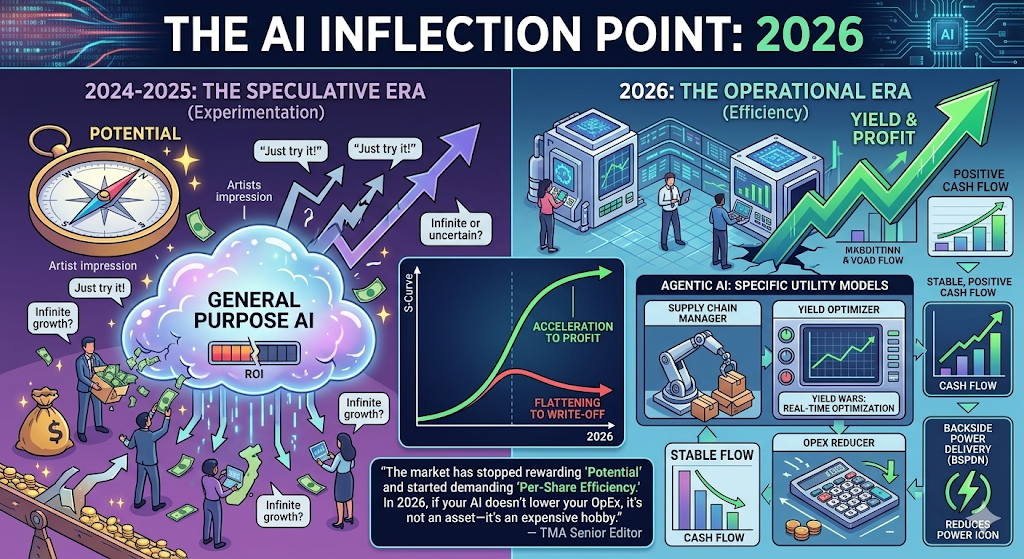
For two years, the market accepted “Experimentation” as a valid reason for negative margins. In 2026, that patience has evaporated. We have reached the Inflection Point. The focus has shifted from training massive, monolithic models to the deployment of “Agentic AI” that actually replaces high-cost operational workflows.
As I analyzed in The AI Capex Threshold, the sheer cost of energy and silicon has made “General Purpose AI” a luxury few can afford. The real profit is now being harvested by firms that have successfully pivoted to “Specific Utility” models—AI that doesn’t just chat, but autonomously manages supply chains or optimizes Yield Wars in real-time. This is the year where the “S-Curve” of AI adoption either accelerates into profit or flattens into a massive corporate write-off.
The TCO Wall: Why 2026 is the Deciding Year
The Total Cost of Ownership (TCO) has become the most feared metric in Silicon Valley. We aren’t just looking at the price of an H100 anymore; we’re looking at the 5-year maintenance of liquid-cooled data centers and the soaring cost of “Clean Data” licensing.
The companies that will “bleed black” this year are those utilizing the technologies discussed in The Backdoor Revolution: BSPDN. By moving the power delivery to the backside of the wafer, they are finally seeing the 30% reduction in power-per-token that makes large-scale inference economically viable. Efficiency is no longer a technical goal; it is a fiduciary duty.
“The market has stopped rewarding ‘Potential’ and started demanding ‘Per-Share Efficiency.’ In 2026, if your AI doesn’t lower your OpEx, it’s not an asset—it’s an expensive hobby.” — TMA Senior Editor
TMA Fact Check 2026: The ROI Reality
- The Inference Pivot: In 2026, 80% of AI spending has shifted from “Training” to “Inference.” This is where the actual money is made, but it requires massive optimization that many “Hype-Era” startups lack.
- The Subscription Fatigue: Enterprise SaaS providers are hitting a wall. Companies are refusing to pay “AI Premiums” unless they see a documented 25% increase in departmental efficiency.
- The Labor Deflation: The only area where AI is showing immediate ROI is in the reduction of mid-level administrative overhead, a cold reality that is reshaping the white-collar labor market.
Related Deep Analysis
- The AI Capex Threshold: The Cold Judgment of ROI in 2026
- The Backdoor Revolution: BSPDN and the Great Recalibration of the 2nm Foundry War
- AGI Bubble or Market Realignment?
The Sharp Question
Are you waiting for a “Magic AGI” to save your portfolio, or are you tracking the ruthless unit economics of inference costs? In 2026, the winners aren’t the ones with the smartest models, but the ones with the most profitable spreadsheets.
#AI ROI #Tech Macro #Capex Efficiency #Agentic AI #Big Tech Earnings #2026 Market Analysis,