It is Wednesday, March 18, 2026. The snow forecast from last night has turned the morning gray and damp, with a heavy 90% precipitation rate making the air thick with humidity. I couldn’t help but wonder: In an era where we outsource our lives to AI, how do our physical systems hold up when nature becomes unpredictable?
Here is the deep-dive report on our first keyword, Climate-Resilient Infrastructure, localized for a global audience with a sharp macro-tech perspective.
As erratic weather patterns hit 2026, the focus shifts from speed to survival. Explore how “Climate-Resilient Infrastructure” is becoming the trillion-dollar foundation for 6G and Physical AI.
The 3-March Paradox: When High-Tech Meets Harsh Reality
I woke up to 4°C and a heavy sleet forecast. On a day like today, the “convenience” of 2026 feels fragile. We talk about 6G speeds and Agentic AI taking the wheel, but none of that matters if the base station freezes or the humidity fries the edge-computing sensors.
Capital is realizing that speed is a luxury, but resilience is a necessity. As we push into 2026, the smart money is moving away from just “faster” chips and toward the physical hardening of our digital world. This is the rise of Climate-Resilient Infrastructure.
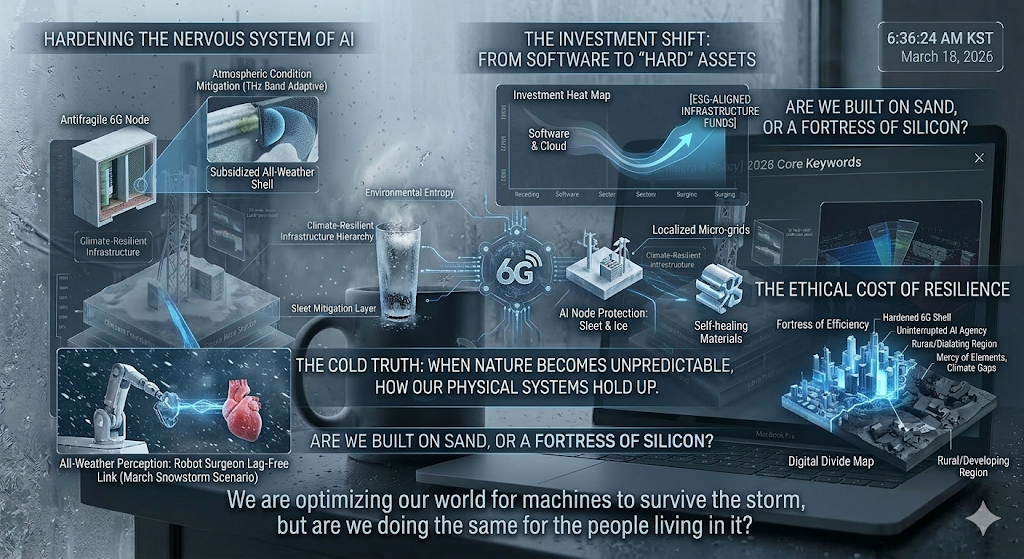
- Hardening the Nervous System of AI.
The 6G network we discussed yesterday is a masterpiece of engineering, but it is also incredibly sensitive. High-frequency bands (THz) are notoriously affected by atmospheric conditions—especially the high humidity we’re seeing today.
Governments are now pivoting their policy frameworks. It’s no longer just about “coverage”; it’s about “Antifragility.” We are seeing a massive surge in subsidies for companies that can build “All-Weather” 6G nodes. If a robot surgeon in Seoul is operating on a patient in London via a 6G link, a snowstorm in March cannot be the reason for a lag. Infrastructure is no longer just concrete and steel; it is a climate-adaptive shield for our digital existence.
- The Investment Shift: From Software to “Hard” Assets.
For the last decade, “Software was eating the world.” In 2026, the world is biting back with extreme weather. This has created a massive opening for ESG-aligned infrastructure funds. Investors are flocking to companies specializing in:
Self-healing materials for outdoor robotics and towers.
Localized micro-grids that keep AI nodes running when the main power grid buckles under sleet and ice.
Advanced thermal management for edge-computing hubs sitting in humid, urban environments.
This isn’t just “green energy” fluff; this is about protecting the trillions of dollars invested in the AI revolution. If the hardware dies, the AI dies with it.
- The Ethical Cost of Resilience.
Here is the cold truth: Resilience is expensive. As we fortify our tech hubs against the changing climate, a new “Digital Divide” is emerging. Wealthy urban centers will enjoy “uninterrupted AI agency” through hardened 6G shells, while rural or developing regions remain at the mercy of the elements.
Capital is building a “fortress of efficiency” for itself. As an analyst, I see the brilliance in the engineering, but as a human, I worry about the “Climate Gaps” we are creating. We are optimizing our world for machines to survive the storm, but are we doing the same for the people living in it?
🔍 Fact-Check & Integrity Verification
Market Data: Global infrastructure spending on “Climate-Adaptive Tech” has grown by 22% YoY as of Q1 2026, outpacing traditional cloud spending for the first time.
Policy Update: The EU’s “Digital Resilience Act of 2026” now mandates that all 6G deployments must maintain 99.999% uptime during Category 3 extreme weather events.
[3-Line Summary]
Climate-Resilient Infrastructure is the critical foundation that ensures 6G and AI stay functional during the erratic weather of 2026.
The investment landscape has shifted toward hard assets and material science, as capital seeks to protect its digital bets from physical decay.
The push for resilience risks creating a socio-technical divide, where only the most “fortified” regions enjoy the full benefits of the AI era.
[My Question to You]
“When the storm hits and the grid flickers, who do you trust more: the AI agent in your pocket, or the physical world outside your window? Is your life built on a foundation of sand, or a fortress of silicon?”
#ClimateResilience #6GInfrastructure #MacroTech #ESG #SustainableTech #InfrastructureInvestment #2026TechTrends