The sharp wind rattling the window frames of my Nusan-ri studio serves as a cold reminder that nature remains indifferent to our system uptime. I stare at the power consumption metrics of the latest Blackwell clusters, taking a long, searing swallow of espresso. The hot liquid burns as it goes down. We have hit a wall, and the only way through is the physics of splitting the atom.
In 2026, the AI boom hits the “Power Wall.” Discover how Microsoft, Amazon, and TerraPower are utilizing SMRs and nuclear restarts to secure the energy-dense future of compute.
The 1,000 TWh Threshold: AI’s Insatiable Hunger
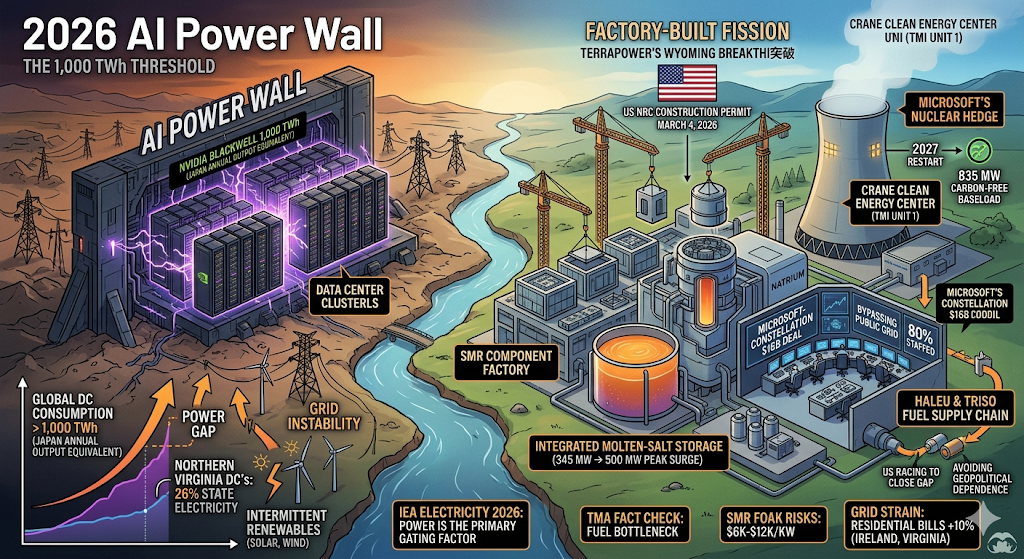
By March 2026, the numbers have moved from dire projections to cold reality. Global data center electricity consumption has officially surpassed 1,000 TWh this year—a figure roughly equivalent to the total annual power output of Japan.
The “Power Gap” is the new silicon shortage. In northern Virginia, the world’s data center capital, these facilities now devour nearly 26% of the state’s total electricity. We are witnessing a phase of Geopolitical Friction where digital sovereignty is being traded for grid stability. Hyperscalers have finally accepted that solar and wind, burdened by fundamental intermittency, cannot sustain the 24/7/365 requirements of modern inference engines.
Factory-Built Fission: TerraPower’s Wyoming Breakthrough
The strategic pivot of 2026 is the industrialization of nuclear energy. We’ve moved past the “paper reactor” phase. On March 4, 2026, Bill Gates-backed TerraPower secured a historic NRC construction permit for its Natrium plant in Wyoming.
This is the first commercial-scale, non-light-water reactor to be approved in the US in over 40 years. It’s not just a power plant; it’s a blueprint for “Factory-Built Fission.” With integrated molten-salt energy storage, the 345 MW plant can surge to 500 MW to handle peak AI training loads. However, the TMA Fact Check remains cautious: the “Hardest Part” is just beginning as TerraPower moves from regulatory victory to the brutal reality of nuclear supply chain logistics.
The Billion-Dollar Restart: Microsoft’s Nuclear Hedge
Microsoft is playing for speed, not just innovation. Their $16 billion deal with Constellation Energy to restart the Crane Clean Energy Center (formerly Three Mile Island Unit 1) is currently running ahead of schedule.
As of this month, the facility is nearly 80% staffed, with a 2027 restart date now looking increasingly likely. While Small Modular Reactors (SMRs) offer long-term TCO benefits, the Crane restart provides 835 MW of carbon-free baseload power years before any new SMR hits the grid. This is the new capital reality: Big Tech is no longer just buying software; they are underwriting the global nuclear transition to bypass a failing public grid where power spreads are rising by 15%.
“The energy consumption of large data centers can equate to millions of homes… Securing reliable power is now the primary gating factor in AI development.” — IEA Electricity 2026 Report.
TMA Fact Check 2026
- The Fuel Bottleneck: While reactor designs are advancing, the supply of HALEU (High-Assay Low-Enriched Uranium) and TRISO fuel remains a critical vulnerability. The US is still racing to close a “longstanding gap” in the nuclear fuel cycle to avoid dependence on external geopolitical rivals.
- The Price of Entry: A 300 MW SMR module is targeting a $1 billion entry point, but first-of-a-kind (FOAK) risks have kept early deployment costs high, ranging from $6,000 to $12,000 per kW.
- The Grid Strain: In 2026, residential electricity bills in AI hubs like Ireland and Virginia are rising by 8-10%, as utilities pass the cost of massive infrastructure upgrades onto the public, fueling local resentment against “Big Compute.”
Related Deep Analysis
- [The On-Device AI Mirage: Why Your 2026 PC Is a Local LLM Prison]
- [Algorithmic Sovereignty: The Geopolitics of Energy-Dense Compute]
The Sharp Question
As Big Tech effectively “privatizes” nuclear baseload power to feed its AI ambitions, are we entering a future where the public grid is left with the crumbs of intermittent renewables while the elite compute clusters hum on stable, atomic energy?
#SMR #Nuclear Energy #AI Infrastructure #Microsoft #TerraPower #Data Center Power #2026 Tech Macro