The biting wind from the Han River rattles the windows of my Gimpo studio this morning. It is a cold, stark reminder that geography—physical, inescapable geography—still dictates the terms of power in 2026. While the techno-optimists talk about the “weightless” cloud, the real war is being fought in the heavy, sun-scorched dirt of Northern Mexico.
A critical analysis of Mexico’s 2026 transformation into an AI infrastructure hub. Explore why Nvidia and Foxconn are abandoning the ‘Reshoring’ myth for the ‘Silicon Desert’.
The Death of the Reshoring Myth
For years, we were fed the political fantasy of “Reshoring”—the idea that high-tech manufacturing would return to US soil. It was a lie. In 2026, the TCO (Total Cost of Ownership) in the United States remains a bureaucratic and inflationary nightmare.
Instead, we have “Nearshoring.” Mexico has become the terminal station for the “China Plus One” strategy. Nvidia and Foxconn aren’t moving there for the culture; they are building the “Silicon Desert” because it is the only place where the physical infrastructure of AI—server racks and liquid cooling systems—can be produced at scale without the trans-Pacific shipping risks.
Beyond the Screwdriver: The OSAT Shift
The most critical development I am tracking is the migration of Semiconductor OSAT (Outsourced Semiconductor Assembly and Test) to regions like Jalisco. Mexico is no longer just a place to bolt car doors together. It has become a strategic weapon in the global Yield War.
As I noted in The Blind Robot in the Sleet, the reliability of AI hardware depends on a stable, proximal supply chain. By moving the “final breath” of semiconductor manufacturing to the North American corridor, Big Tech is attempting to insulate itself from the Geopolitical Friction that has paralyzed East Asian logistics.
“Mexico’s rise isn’t a miracle of local innovation. It is an opportunistic grab at the vacuum left by the US-China divorce. Their success depends entirely on whether they can fix their crumbling power grid before the AI factories drain it dry.” — TMA Senior Editor
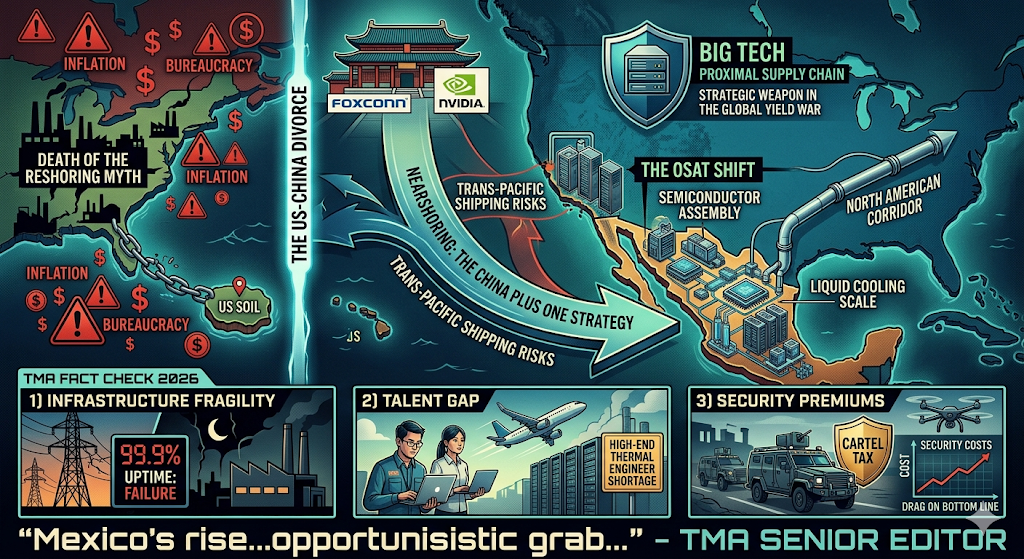
TMA Fact Check 2026
- Infrastructure Fragility: Despite the hype, Mexico’s power grid remains an Achilles’ heel. AI server plants require 99.9% uptime, which the current state-run utility cannot yet guarantee.
- The Talent Gap: While labor is abundant, the “High-End Thermal Engineer” shortage is real. Companies are currently flying in experts from Taiwan to manage Mexican plants, a cost that isn’t reflected in the “low-cost” narrative.
- Security Premiums: The “Cartel Tax”—the hidden cost of securing logistics routes—remains a significant drag on the bottom line for any firm operating outside the major tech corridors.
Related Deep Analysis
- Tesla’s Q3 Earnings: A Mirage of Autonomy
- The Blind Robot in the Sleet
- The 2026 Resilience Report: How to Survive the 6G Era
The Sharp Question
Are you still viewing Mexico as a “budget factory” for the US, or do you see it for what it really is: the strategic fortress that will decide who wins the AI infrastructure race of the late 2020s?
#Nearshoring #Mexico Tech #AI Infrastructure #Supply Chain 2026 #Geopolitics #Semiconductor OSAT #TCO