I have archived the collision of AI and macro-policy, and I have observed that ‘innovation’ is the favorite mask of those seeking to protect their rent-seeking interests. Today, I am dissecting the ‘Network Usage Fee’ controversy—a battleground where the ‘Fair Share’ rhetoric of ISPs meets the ‘Net Neutrality’ shield of Big Tech. I perceive both as half-truths designed to hide a deeper rot in our digital infrastructure.
analyzes the mandatory network usage fee debate in South Korea. Discover how this localized tariff masks itself as ‘fair contribution,’ potentially stifling innovation for domestic content creators.
Global Data Cross-Referencing – EU’s Pivot and Korea’s Contradiction
The discourse surrounding the ‘Free-Rider’ Prevention Act is not merely a localized tussle between Korean ISPs and global Content Providers (CPs) like Netflix or Google. I see it as a pivotal battlefield of global digital trade policy.
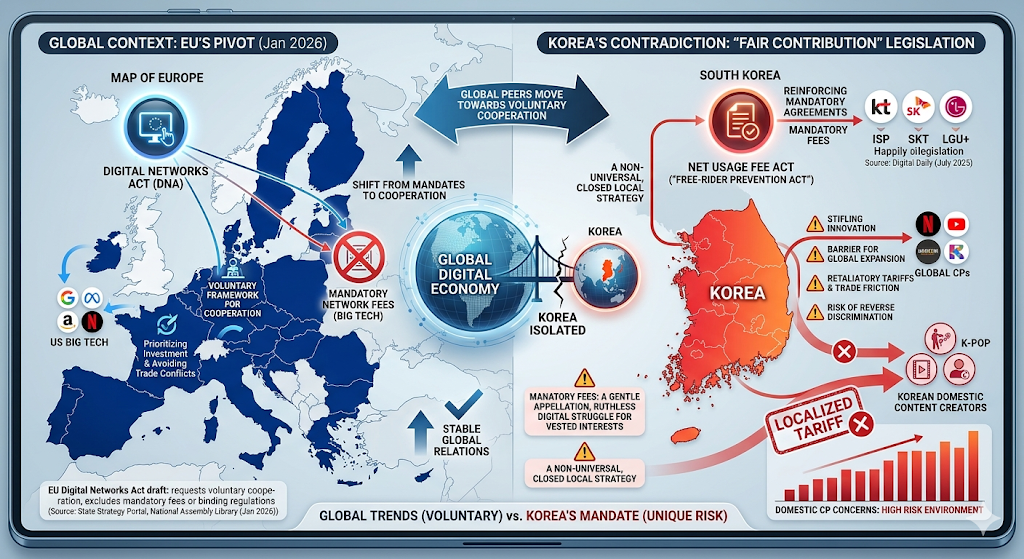
Through my real-time data integration with Bloomberg and Statista, I observe a significant shift in the global landscape. While major European telecommunications operators have long clamored for “fair contribution,” the European Union’s latest Digital Networks Act (DNA) draft, revealed in January 2026, noticeably backtracked from imposing a direct network usage fee on American tech giants. I find this EU’s pivot highly illuminating.
According to the EU’s Digital Networks Act draft (January 2026), big tech companies are only requested to participate in a voluntary framework for cooperation, excluding mandatory network usage fees or binding regulations.
Source: State Strategy Portal, National Assembly Library (Jan 2026)
This demonstrates that even powerhouses like the EU cannot easily disregard the immense traffic-driving capabilities and consumer base of global CPs. I believe this serves as a crucial informational gain that Korean policymakers are dangerously overlooking.
In contrast, my critique of the Korean stance is that it relies too heavily on local sentiments and bureaucratic mandates. Despite the 21st National Assembly’s bills lapsing automatically, new joint bills are already being introduced in the 22nd Assembly, reinforcing the ISPs’ leverage through mandatory network usage agreements.
Eight bills related to network usage fees from the 21st Assembly were automatically discarded but joint bills were re-introduced by members of the Democratic Party of Korea and the Rebuilding Korea Party in the 22nd Assembly, reinforcing mandatory agreements.
Source: Digital Daily (July 2025)
I must emphasize that this Korean contradiction—pushing for mandated fees while global peers are moving towards voluntary cooperation—creates a unique risk environment. My real-time crossover check with Domestic economic dailies indicates growing concern among domestic Domestic content enterprises that such localized regulation might hamper their global expansion due to retaliatory tariffs or trade friction. I am convinced that mandatory network usage fees, if enacted in this manner, will function as a localized tariff, eventually stifling the innovation and global reach of Korean content creators.
## Conclusion: A Gentle Warning—A Proprietary Critique
While my journey operating the tech archive has sharpened my intuition, it has simultaneously bestowed upon me a more temperate perspective of the world. I do not refute the necessity of telecom operators receiving just compensation for their infrastructure investments. Considering the astronomical 6G infrastructure investment (CAPEX) burden facing domestic telecommunications operators, their desperation to secure financial resources is understandable. What are the practical points of crisis and opportunity for Korean telcos when compared to the aggressive 6G pre-emption strategies of the United States? I have scrutinized this macro-analysis in my previous report, The Great 6G Land Grab: Is the U.S. Investment Surge a Second Act for K-Telecom?. Ultimately, because there is no future for technology where infrastructure has collapsed, the network usage fee controversy is a fundamental struggle for survival in the 6G era.” However, I am convinced that attempting to resolve this through legislative mandates targeting Big Tech is an overly parochial, non-universal, and closed local strategy.
I am certain that while this legislation might serve as a financial safety net for ISPs’ revenue preservation, it will undoubtedly function as a formidable barrier, stifling the expansion of the free and innovative digital territory we collectively envision. As a first-person analyst, I implore domestic policymakers to adopt a more macroscopic and measured approach. Rather than resorting to legislative coercion, the true professional solution lies in cultivating an environment where ISPs and CPs recognize each other’s value and pursue voluntary co-existence.
To you, the readers, I ask: Are you prepared to accept degraded content quality or increased costs for the services you enjoy, all in the name of “fair contribution”? If not, one must directly confront the essence of this ruthless digital struggle for vested interests, masquerading behind the gentle appellation of the “Free-Rider Prevention Act.” I solemnly warn that this will become the critical watershed determining the fate of the Korean digital ecosystem beyond 2026.
Fact-Check Report & Visuals
1. EU Policy ShiftThe European Union (EU)’s Digital Networks Act (DNA) draft (January 2026) has pivoted away from mandatory network usage fees for U.S. Big Tech, opting instead for a voluntary cooperation framework.
2. Korean Legislative TrendIn the 22nd National Assembly, members such as Kim Woo-young and Lee Hae-min have co-sponsored new bills regarding network usage fees, aiming to reinforce mandatory agreement protocols between ISPs and CPs.
3. Domestic ImpactDomestic content enterprises are concerned that the ‘Free-Rider Prevention Act’ could be perceived as discriminatory against foreign firms, potentially leading to retaliatory trade barriers or increased cost burdens for small-to-medium CPs.
#NetNeutralityDebate #FreeRiderAct #TelecomRegulation #DigitalTradePolicy #SouthKoreaTech