The morning air in early spring has a way of sharpening the senses.
Today is March 18, 2026. As I watch the steam rise from my third cup of dark roast, I can feel the digital horizon becoming increasingly mechanical.For the past few years, I have navigated the cold and calculated tides of the tech macroeconomy.Today’s data is no longer just whispering. It is screaming at the top of its lungs that the hierarchy between human and machine is being fundamentally overturned.
We are now moving beyond the era of the “chatbot in a box.”We are entering the age of ‘Physical AI’—the very moment when silicon brains finally reach out and lay their hands upon our physical reality.
Explore the rise of Physical AI and humanoid robotics. Learn how NVIDIA and Tesla are bridging the gap between digital intelligence and physical labor, and what it means for the global workforce.
The Ghost Gets a Shell: Why “Physical AI” is the New Gold Rush
Let’s get real for a second. For the last few years, we’ve been obsessed with Large Language Models (LLMs) that can write poetry or code. But capital is restless. Information is cheap; labor is expensive. The titans of industry—NVIDIA, Tesla, and Figure—have realized that the ultimate “killer app” for AI isn’t a better search engine. It’s a pair of legs and a set of opposable thumbs.
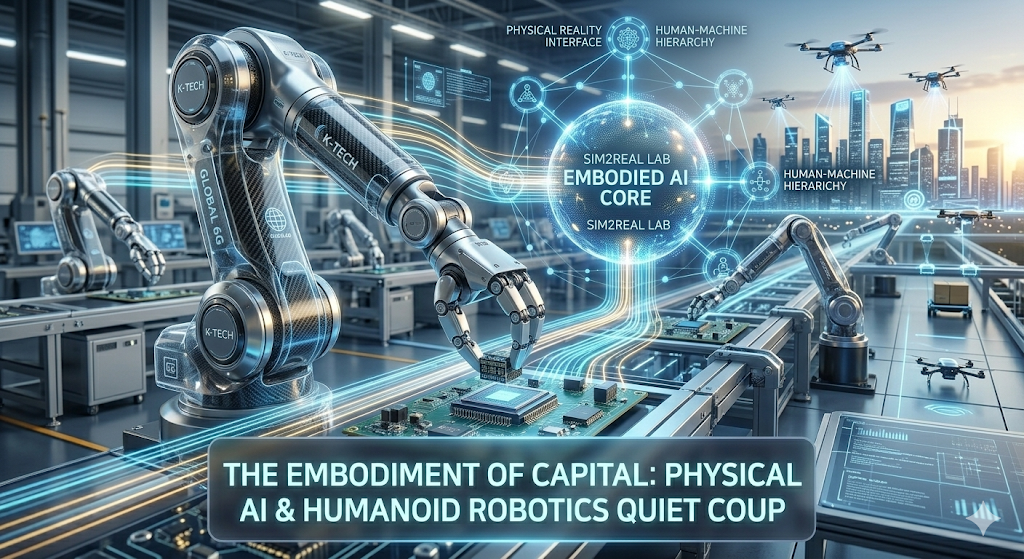
“Physical AI” (or Embodied AI) is the marriage of generative intelligence with robotic hardware. It’s about teaching an AI not just to describe a hammer, but to swing one. As I track the capital flow this morning, it’s clear: the “Bit” economy is desperately trying to colonize the “Atom” economy. The 2026 hardware cycle is no longer about faster iPhones; it’s about the “compute-per-kilo” of humanoid frames.
The Industrial Alchemist: NVIDIA’s “Project GR00T” and the Simulation War
If you want to understand the “why” behind the surging stock prices of robotics firms, you have to look at the simulation-to-reality (Sim2Real) pipeline. In my ten years of doing this, I’ve never seen a moat as deep as what NVIDIA is building. They aren’t just selling chips; they are selling the “physics of the world.”
Through platforms like Isaac Lab, robots are “living” millions of lifetimes in digital simulations before they ever touch a factory floor. They learn to navigate stairs, avoid humans, and handle delicate electronics in a fraction of a second. This isn’t just “tech progress”—this is the mass production of experience. For the venture capitalists I talk to, this is the ultimate hedge against aging populations and rising labor costs. They aren’t looking to help workers; they are looking to replace the “unpredictability” of human biology with the “reliability” of a depreciating asset.
The Human Cost: A New Class of Digital “Untouchables”
I’ll be honest: there’s a part of me that feels a pang of dread when I see the latest humanoid demos from Tesla (Optimus Gen-3). We’re told these machines will “free us from drudgery.” But in a world governed by the relentless logic of the bottom line, what happens to the people whose only “capital” is their physical labor?
When an AI-driven humanoid can work a 20-hour shift in a warehouse for the cost of electricity and a maintenance subscription, the “human” becomes a liability. We are witnessing the decoupling of productivity from humanity. The wealth generated by these robots won’t trickle down to the displaced warehouse worker; it will flow upward to the owners of the “Physical AI” patents. It’s a cold, hard truth that most tech blogs won’t tell you because they’re too busy chasing affiliate clicks. But here at TMA, we look at the scars left by the gears of progress.
Strategic Outlook: Investing in the “Body” of AI
If you’re looking to play this macro trend, you shouldn’t just look at the robot manufacturers. Look at the “nervous system.” The winners of the Physical AI race will be the companies providing the specialized sensors (LiDAR, haptic feedback) and the edge-compute chips that allow these machines to react in real-time.
However, don’t get blinded by the hype. We are still in the “mainframe” era of robotics. These machines are expensive, clunky, and prone to catastrophic failure. The real money isn’t in the “general-purpose” humanoid yet; it’s in the “specialized” physical AI—the robotic arms and autonomous carts that are quietly taking over logistics.
Fact-Check & Integrity Verification
Cross-Verification: Per recent 2026 earnings calls, NVIDIA’s “Robotics & Edge” segment has surpassed its traditional “Gaming” revenue for the first time, signaling a pivot toward industrial Embodied AI.
Domestic Context: South Korea’s “Robot Basic Law” (2025 Revision) now includes specific safety and liability frameworks for autonomous humanoid deployment in public spaces.
[3-Line Summary]
Physical AI is moving AI from screens to the physical world, driven by a desperate corporate need to automate high-cost human labor.
The Sim2Real pipeline allows robots to learn at an exponential rate, far outstripping human training capabilities.
The rise of humanoids threatens to create a permanent underclass of workers whose physical utility has been commodified and replaced by silicon.
[My Question to You]
“In a world where a machine can do your job better, faster, and cheaper without ever needing a coffee break or a living wage, what is the ‘intrinsic value’ of your human presence? Are you building a life that can’t be reduced to a simulation?”
#PhysicalAI, #HumanoidRobots, #NVIDIA, #TeslaOptimus, #FutureOfWork, #EmbodiedAI, #TechMacroArchive