As of March 2026, the semiconductor industry pivots from plastic to glass substrates and from standard to custom HBM4, redefining the physical limits of AI compute.
Analysis 1: The Glass Substrate Shift — Shattering the Thermal Ceiling
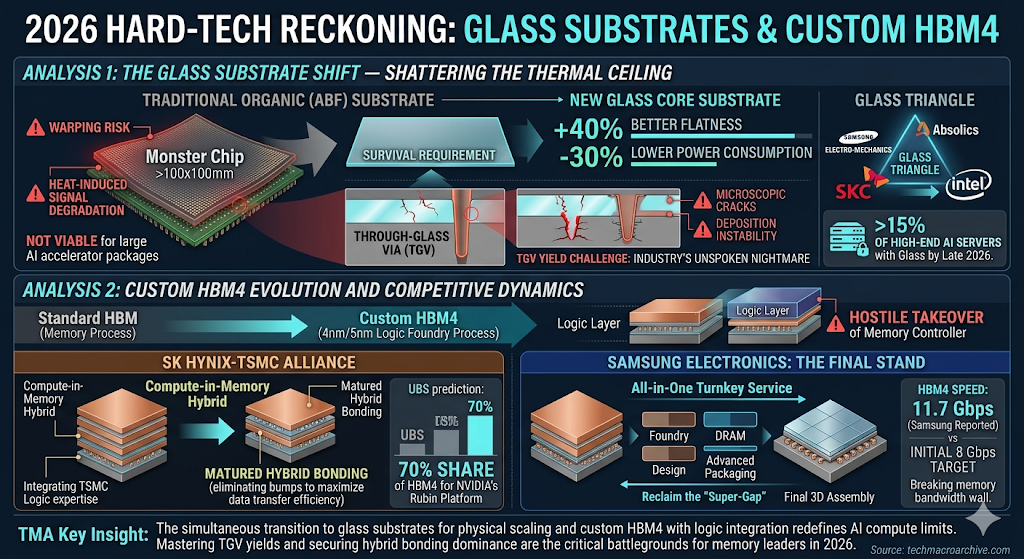
The semiconductor industry has finally admitted that organic (ABF) substrates are no longer viable for the “Monster Chips” of 2026. As AI accelerators exceed 100x100mm in package size, the warping and heat-induced signal degradation of traditional plastic substrates have become intolerable. Glass is no longer a luxury—it is a survival requirement.
I am tracking a brutal race within the “Glass Triangle” (Samsung Electro-Mechanics, SKC’s Absolics, and Intel). Glass offers 40% better flatness and 30% lower power consumption, but the yield challenges in Through-Glass Via (TGV) formation—specifically micro-cracking and deposition stability—remain the industry’s unspoken nightmare. In 2026, the company that masters the fragility of glass and stabilizes TGV yields will hold the keys to the next decade of High-Performance Computing (HPC).
Analysis 2: HBM4 — The Identity Crisis of Memory
2026 marks the year HBM stopped being “just memory.” With the transition to HBM4, the base die is moving from traditional memory processes to logic foundry processes (4nm/5nm). This isn’t a mere upgrade; it’s a hostile takeover of the memory controller by the logic layer.
The SK Hynix-TSMC alliance has fundamentally changed the power dynamics of the supply chain. By integrating TSMC’s logic expertise directly into the HBM4 stack and maturing Hybrid Bonding techniques (eliminating bumps to maximize data transfer efficiency), they are creating a “Compute-in-Memory” hybrid that threatens the traditional modular approach.
In response, Samsung Electronics—the only player with world-class Foundry, DRAM, and Advanced Packaging capabilities—is making its final stand to reclaim the “Super-Gap” by offering an All-in-One Turnkey Service, handling everything from design to final 3D assembly.
TMA Fact Check 2026
- HBM4 Speed: HBM4 has shattered JEDEC standards. Samsung has reported data speeds of 11.7 Gbps, nearly 50% faster than the initial 8 Gbps targets, effectively breaking the memory bandwidth wall.
- The Substrate Transition: Market analysts project that by late 2026, over 15% of high-end AI servers will ship with glass core substrates, primarily reserved for mission-critical enterprise agents.
- The SK Hynix Lead: UBS predicts SK Hynix will maintain a 70% share of the HBM4 market for Nvidia’s upcoming Rubin platform, thanks to its matured Hybrid Bonding collaboration with TSMC.
Related Deep Analysis
- [The SMR Gold Rush: Big Tech’s Nuclear Utilities]
- [The High-NA Yield Wall: Intel’s Gamble vs. TSMC’s Pragmatism]
- [Yield War: Samsung’s 2nm Struggle and Micron’s HBM4 Coup]
The Sharp Question
“Will the traditional ‘Fabless’ model survive, or are we entering a new era of ‘Vertical Monopolies’ where only companies who control the entire stack—from the atom to the algorithm—can survive?”
#GlassSubstrate #HBM4 #HybridBonding #TGV #Samsung #SKHynix #TSMC #AdvancedPackaging #2026TechMacro