In March 2026, the economics of AI have shifted to autonomous digital workers. Explore the brutal reality of task arbitrage, reasoning tokenomics, and the hidden TCO of the agentic workforce.
The Great Labor Decoupling: $140K vs. $6K
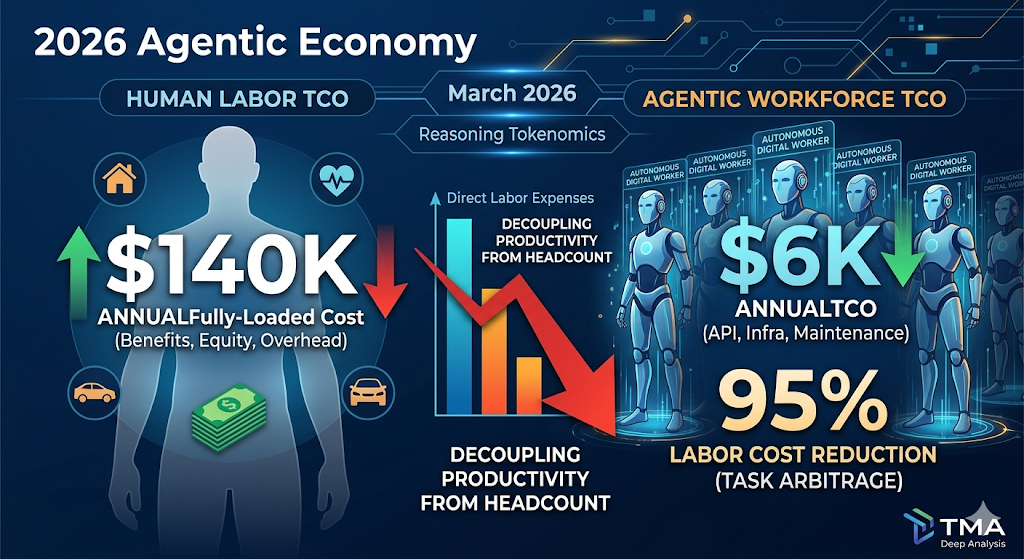
The macro-economic pivot of 2026 is no longer about “augmentation”—it is about Task Arbitrage. According to recent March 2026 data, a mid-level human employee in a knowledge-heavy role (marketing, software QA, or document review) carries a fully-loaded TCO of $120,000 to $150,000 annually once benefits, real estate, and management overhead are factored in.
In contrast, a production-grade Autonomous Digital Worker currently costs between $3,000 and $6,000 per year. This represents a staggering 95% reduction in direct labor costs for specific multi-stage workflows. We are witnessing the first true decoupling of productivity from headcount. For G2000 CEOs, the goal is no longer growing the team; it is growing the “Agentic Fleet.”
The “Reasoning Tax” and the Tokenomics of 2026
But the floor isn’t as solid as the vendors claim. While the cost of simple tokens has plummeted, the cost of Reasoning Tokens (GPT-5, Claude 4 Opus) remains a high-margin stronghold for foundation model providers.
In the Software Development Life Cycle (SDLC), recent traces show that the Automated Code Review stage now accounts for 59.4% of total token consumption. Agents don’t just “write” once; they iterate, verify, and loop. This non-deterministic behavior makes AI budgeting a nightmare. A single autonomous agent caught in a “hallucination loop” can burn through $500 of API credits in minutes. This is why AI FinOps has become the most critical job description in 2026.
The Margin Death by a Thousand Loops
The industry is hitting a “Reality Check.” Gartner and IDC report that 40% of agentic AI projects are slated for cancellation or “zombie status” by 2027 due to escalating operational costs. The friction lies in the “Fragmentation Tax”—the cost of orchestrating multiple agents across legacy ERP and CRM systems.
| Role | Human TCO (Annual) | AI Agent TCO (Annual) | ROI Break-even |
|---|---|---|---|
| Customer Support | $55,000 | $2,400 | < 1 Month |
| Software QA | $110,000 | $12,000 | 3 Months |
| Financial Auditing | $135,000 | $25,000* | 6 Months |
| *Includes high-end compliance & reasoning model overhead. |
“By 2026, 70% of G2000 CEOs will focus AI ROI on growth, driving C-suite efforts to boost revenue without growing headcount.” — IDC FutureScape 2026.
TMA Fact Check 2026
- The Arbitrage Outperformance: Stocks of companies with low-labor-cost ratios outperformed high-labor-cost peers by 8 percentage points in the last fiscal year, signaling that the market is already pricing in agentic efficiency.
- The Hidden Build Cost: A production-grade agent isn’t just a $20 subscription. Enterprise-grade development, security, and integration typically cost $100,000 to $300,000 upfront before the first task is even executed.
- The Sovereignty Squeeze: As analyzed in [The Silicon Iron Curtain], EU-based firms are paying a 15-20% “Compliance Premium” on agents to meet localized governance and auditability requirements.
Related Deep Analysis
- [The Death of the Assistant: Why 2026 is the Year of the Autonomous Digital Worker]
- [The $700 Billion Sprint: Is Big Tech’s AI CAPEX Hitting a Terminal Peak?]
- [The Silicon Iron Curtain: Big Tech’s Brutal Collision with the EU AI Act]
The Sharp Question
If we successfully replace 40% of the “digital middle class” with $6,000-a-year agents, we solve the corporate yield war—but who is left with the purchasing power to buy the products those agents are optimizing? Are we building a hyper-efficient economy with no one at the other end of the transaction?
#AI Economics #Agentic AI #Digital Workers #ROI 2026 #AI FinOps #Tokenomics #Tech Macro