In March 2026, NVIDIA’s total exit from ARM signals a new era of tech nationalism. Explore how ARMv9, Sovereign AI, and the RISC-V threat are redrawing the semiconductor supply chain.
The Post-NVIDIA Era: The Death of the $40B Dream
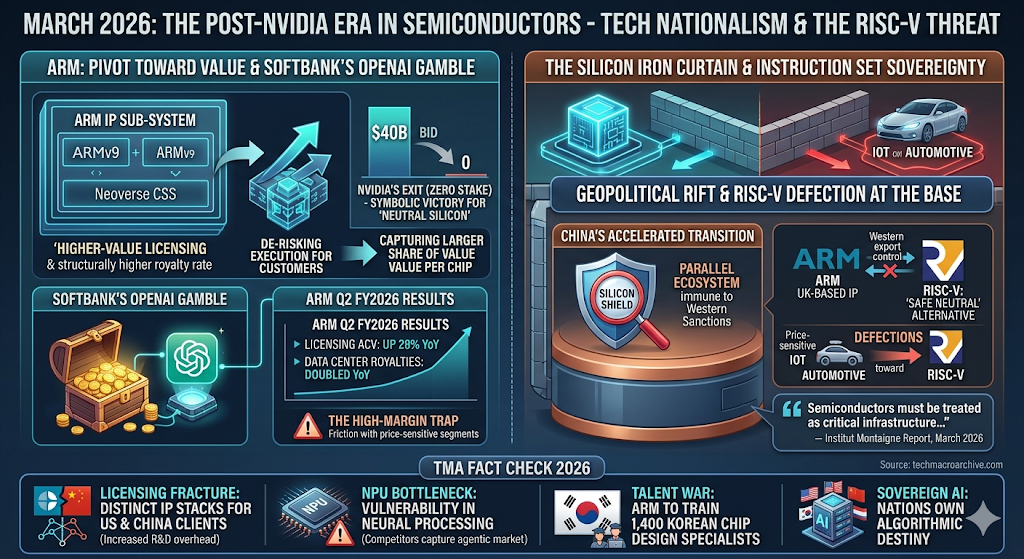
As of March 2026, the long shadow of the failed NVIDIA-ARM merger has finally vanished. Regulatory filings confirm that NVIDIA has reduced its stake in ARM to zero, ending a complex relationship that began with a $40 billion takeover bid five years ago. This exit isn’t just a financial footnote; it is a symbolic victory for the “Neutral Silicon” camp. Regulators in the EU, US, and UK successfully argued that ARM’s independence was essential for the world’s cutting-edge semiconductors. However, the irony of 2026 is that ARM’s independence has not led to global unity, but to a more fractured, nationalistic IP market.
SoftBank’s Pivot: Funding the OpenAI Gamble
Masayoshi Son is no longer treating ARM as a standalone crown jewel; he is using it as a high-yield engine to power his $22.5 billion investment in OpenAI. ARM’s latest Q2 FY2026 results reflect this shift. The company is aggressively moving toward higher-value licensing and structurally higher royalty rates.
- Licensing ACV (Annual Contract Value): Up 28% YoY, driven by massive demand for ARMv9 and Neoverse CSS (Compute Subsystem).
- Data Center Royalties: These have doubled year-over-year as hyperscalers move away from x86 toward custom ARM-based silicon for power-constrained AI buildouts.
By de-risking execution for its customers through pre-integrated subsystems, ARM is capturing a larger share of the value per chip. But this focus on “Value over Volume” is creating a new friction: The High-Margin Trap.
The RISC-V Threat and Instruction Set Sovereignty
While ARM thrives in the premium segment, the “Silicon Iron Curtain” is driving a massive defection at the base. In March 2026, Tech Nationalism has reached a tipping point. Fearing that ARM’s UK-based IP could be weaponized through Western export controls, China has accelerated its transition to RISC-V.
This isn’t just a technical choice; it is a bid for Instruction Set Sovereignty. China’s “Silicon Shield” now depends on building a parallel ecosystem that is immune to Western sanctions. As ARM raises royalty rates to fuel SoftBank’s AI ambitions, the price-sensitive IoT and automotive markets are increasingly looking at RISC-V as the only “Safe Neutral” alternative.
“Semiconductors must be treated as critical infrastructure, indispensable to strategic resilience and national security. The era of the global, borderless chip is dead.” — Institut Montaigne Report, March 2026.
TMA Fact Check 2026
- The Licensing Fracture: To survive the 2026 geopolitical rift, ARM has been forced to maintain distinct IP stacks for US and China-based clients, increasing R&D overhead and creating a bifurcated software ecosystem.
- The NPU Bottleneck: While ARM dominates the CPU layer, the lack of a unified NPU (Neural Processing Unit) standard remains a vulnerability. Competitors like NVIDIA’s N1 (using ARM cores) are successfully capturing the agentic reasoning market that ARM’s stock architecture still struggles to dominate.
- The Talent War: ARM recently announced plans to train 1,400 chip design specialists in South Korea to bolster its fabless ecosystem, a move designed to diversify its reliance on Western-based engineering talent.
Related Deep Analysis
- [The Silicon Iron Curtain: Big Tech’s Brutal Collision with the EU AI Act]
- [The Rise of Tech-Neutral Nations: Navigating the 2026 Bipolar Fracture]
- [Beyond Blackwell: NVIDIA GTC 2026 and the Birth of the Vera Rubin AI Factory]
The Sharp Question
As ARM moves from being the “Neutral Switzerland” of silicon to a high-yield funding vehicle for SoftBank’s AI dreams, is it inadvertently handing the keys to the future of the global semiconductor supply chain to an un-sanctionable, open-source RISC-V world?
#ARM Holdings #NVIDIA #SoftBank #Tech Nationalism #RISC-V #Sovereign AI #2026 Tech Macro