Explore the 2026 shift in robotics as Physical AI replaces scripted automation. From Tesla’s Optimus Gen 3 to Figure 02’s BMW success, discover the new paradigm of dexterous manipulation.
The End of Scripting: The VLA Paradigm
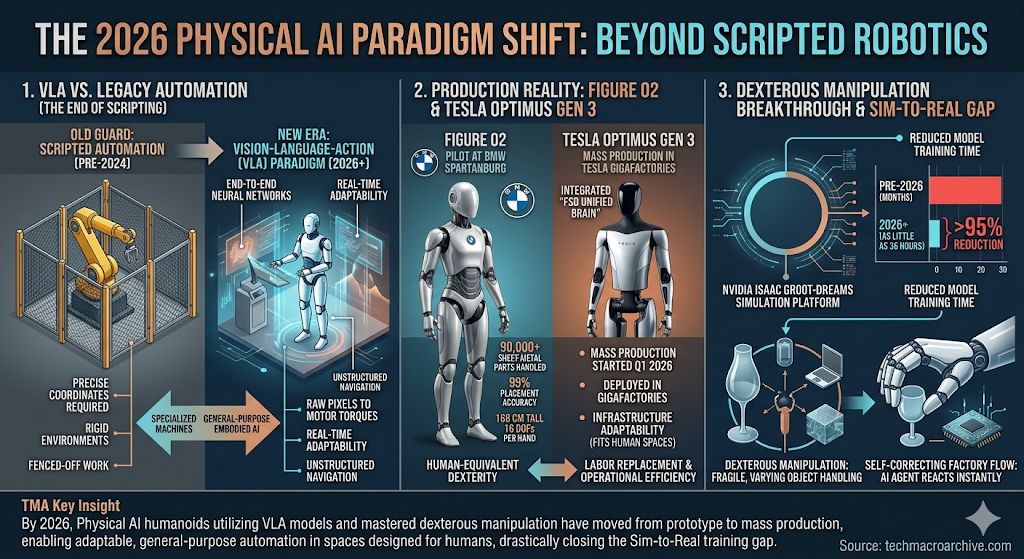
By March 2026, the “Old Guard” of robotics—those giant yellow arms fenced off in cages—has become a legacy tech story. The new paradigm is Vision-Language-Action (VLA) models. Unlike traditional robots that require precise coordinates and rigid environments, the 2026 class of humanoids uses end-to-end neural networks to translate raw pixels into motor torques in real-time.
This “Physical AI” breakout allows robots to navigate unstructured spaces. Whether it’s climbing stairs or navigating a cluttered warehouse floor, the robot isn’t following a map; it’s “perceiving” the physics of the environment. The result is a shift from specialized machines to General-Purpose Embodied AI.
Figure 02 and Tesla Optimus: The Production Reality
The headline grabbers of 2026 are no longer just prototypes.
- Figure 02 has completed its pilot at BMW’s Spartanburg plant, handling over 90,000 sheet-metal parts with a 99% placement accuracy. Standing 168 cm tall with 16 degrees of freedom per hand, it provides human-equivalent dexterity for repetitive high-friction tasks.
- Tesla’s Optimus Gen 3 has officially entered mass production this quarter. Integrated with the “FSD Unified Brain,” Optimus is being deployed within Tesla’s own Gigafactories to handle everything from component transport to machine operation.
This isn’t just about labor replacement; it’s about Infrastructure Adaptability. These robots don’t require factories to be rebuilt; they are designed to fit into spaces built for humans.
The Dexterous manipulation Breakthrough
The most significant technical victory of 2026 is the closing of the “Sim-to-Real” gap. Using high-fidelity simulation platforms like NVIDIA’s Isaac GR00T-Dreams, developers have reduced model training times from months to as little as 36 hours.
By training in synthetic environments that simulate perfect physics, 2026 humanoids have mastered Dexterous Manipulation—the ability to handle fragile, varying objects like glass or micro-electronics without human-coded instructions. This allows for a “Self-Correcting Factory” where the AI agent manages the production flow and reacts to disruptions instantly.
“The question is no longer if you should automate, but how intelligent that automation can be. We are moving from specialized tools to intelligent partners.” — Robotics Trends 2026 Report.
TMA Fact Check 2026
- The Runtime Bottleneck: Despite the hype, current humanoid runtimes are capped at 5 hours due to the energy density of torso-integrated lithium-ion packs. This necessitates “Robot Night Shifts” where battery-swapping infrastructure is as critical as the AI itself.
- The Talent Gap: While the AI is ready, the “Operational Technology (OT)” workforce isn’t. There is a massive global shortage of engineers capable of managing Agentic AI fleets, leading to a new “Deployment Friction” in the mid-market.
- The China Dominance: In the latest CES 2026 data, Chinese firms accounted for 60% of the humanoid exhibitors, signaling a brutal “Yield War” in manufacturing scale that the West is struggling to match.
Related Deep Analysis
- [The On-Device AI Mirage: Why Your 2026 PC Is a Local LLM Prison]
- [The Glass Inflection: Why 2026 Marks the End of Organic Chip Packaging]
- [The $700 Billion Sprint: Is Big Tech’s AI CAPEX Hitting a Terminal Peak?]
The Sharp Question
As we move from robots that follow instructions to robots that “understand” physics, are we prepared for the liability of a non-deterministic workforce—and who owns the data of the physical world that these robots are recording 24/7?
#Physical AI #Humanoid Robots #Tesla Optimus Gen 3 #Figure 02 #Robotics Manipulation #2026 Tech Macro