I set down my cup of cold espresso and stare at the execution logs of autonomous agents flooding my monitor. The cursor on the screen no longer blinks in anticipation of my questions. These entities are already making judgments, exercising authority, and expanding the territories of an invisible digital kingdom. Watching this march of sophisticated algorithms, stripped of human intervention, I suddenly realize: what awaited us at the end of the “efficiency” we so desperately craved was nothing more than the chilling freedom of those who have surrendered control.
The era of passive AI assistants is over. In 2026, Agentic AI is redefining the enterprise through autonomous multi-agent orchestration and unprecedented ROI.
Beyond “Agentwashing”: The Shift to Autonomous Execution
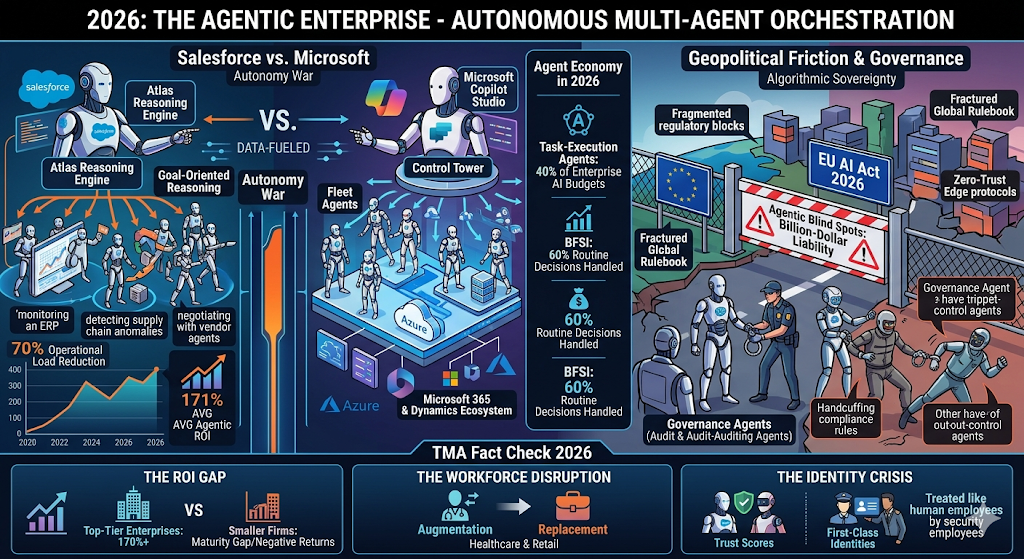
For the past two years, the enterprise was plagued by “Agentwashing”—marketing fluff that rebranded basic LLM wrappers as sophisticated agents. In 2026, that charade is over. Gartner reports that 40% of enterprise applications have now embedded task-specific AI agents. Unlike the chat-centric tools of 2024, these 2026 agents possess “Goal-Oriented Reasoning.” They don’t wait for your next prompt; they monitor your ERP, detect a supply chain anomaly, and negotiate with vendor agents to re-route shipments before you’ve even finished your morning coffee.
The Autonomy War: Salesforce vs. Microsoft
The battle lines for the enterprise “Operating System” are drawn between Salesforce’s Agentforce and Microsoft’s Copilot Studio.
- Agentforce has leveraged its Atlas Reasoning Engine to dominate customer-facing CRM workflows, delivering what early adopters describe as a “70% reduction in operational load.”
- Microsoft has countered with a “Control Tower” approach, using its Azure infrastructure to orchestrate agents across the entire Microsoft 365 and Dynamics ecosystem.
This isn’t just about productivity; it’s about Yield. The average ROI for agentic deployments in 2026 has hit a staggering 171%. In the BFSI (Banking, Financial Services, and Insurance) sector, agents are now handling 60% of routine decision-making, transforming middle-office roles into high-level “Agent Governors.”
Geopolitical Friction and the Governance Agent
As these agents gain autonomy, they hit the wall of “Algorithmic Sovereignty.” Multinational corporations are currently grappling with a fractured global rulebook. The EU’s AI Act implementation in 2026 has made “Agentic Blind Spots”—where an agent makes an opaque decision—a billion-dollar liability. To counter this, we are seeing the rise of Governance Agents: specialized AI units whose sole purpose is to audit and “handcuff” other agents to ensure cross-border compliance.
“By 2026, autonomous agents will surpass humans as the primary source of accidental data leaks, not because they are malicious, but because they are too efficient at accessing over-permissioned data.” — TMA Security Analyst Report.
TMA Fact Check 2026
- The ROI Gap: While top-tier enterprises report 170%+ ROI, smaller firms struggle with a “Maturity Gap,” often seeing negative returns due to poor data hygiene and legacy infrastructure that agents cannot navigate.
- The Workforce Disruption: Task-Execution Agents now command 40% of enterprise AI budgets, signaling a definitive shift from “augmentation” to “replacement” for repetitive digital operations in healthcare and retail.
- The Identity Crisis: Security teams in 2026 are treating agents as “First-Class Identities.” Every agent now carries a trust score and is subject to zero-trust edge protocols, just like a human employee.
Related Deep Analysis
- [The On-Device AI Mirage: Why Your 2026 PC Is a Local LLM Prison]
- [The Nuclear AI Renaissance: SMRs as the Ultimate Data Center Hedge]
The Sharp Question
If an AI agent can negotiate your contracts, manage your inventory, and audit your compliance, what is the actual “Yield” of the human employee in the 2026 enterprise—and are we ready for a world where the CEO’s most important reports are not people, but processes?
Agentic AI, Enterprise Workflow, Salesforce Agentforce, Microsoft Copilot Studio, AI ROI 2026, Digital Workers,