The morning in Gimpo outside the window is submerged in a thick, leaden-gray haze. The skyscrapers visible across the Han River rise dimly, like the massive cooling towers of a data center. The bitterness of cooled espresso lingers on the tip of my tongue, and the cold sensation of the aluminum desk flows along the back of my hand. In 2026, as geopolitical fissures fragment the tech ecosystem, we must face this cold, metallic reality head-on.
In 2026, tech-neutral nations like Vietnam and Mexico are emerging as strategic buffer zones in the US-China tech war, redefining global supply chains.
The Death of Global Connectivity
The illusion of a “flat world” died somewhere between the trade sanctions of 2024 and the full-scale “Algorithmic Sovereignty” mandates of 2025. As a veteran critic watching this unravel from my Gimpo studio, I see a world no longer defined by open markets, but by high-walled gardens. However, in the cracks of this bipolar struggle, a new class of power has emerged: the Tech-Neutral Nations.
Strategic Arbitrage: The New Neutrality
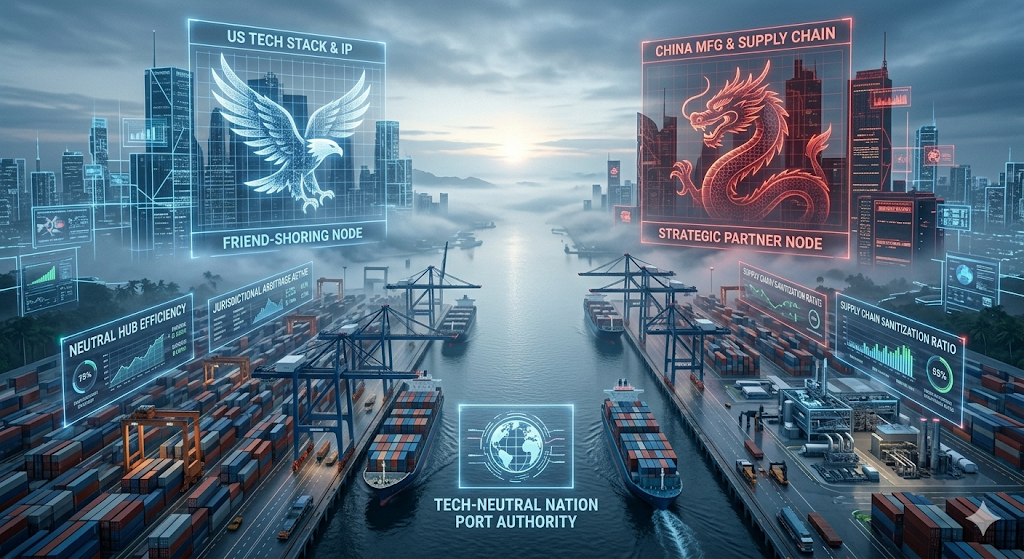
In 2026, being “neutral” is no longer a sign of weakness; it is a high-stakes game of strategic arbitrage. Countries like Vietnam, Malaysia, and Mexico are not merely picking sides. Instead, they are positioning themselves as “Multi-Stack Hubs” where Western design meets Eastern manufacturing efficiency under a neutral legal canopy.
This isn’t just about labor arbitrage anymore—it’s about Jurisdictional Arbitrage. Companies are flocking to these regions to bypass the “Entity List” friction while maintaining access to both the Silicon Valley IP and the Shenzhen supply chain.
“Tech neutrality in 2026 is the art of hosting the adversary’s hardware and the ally’s software on the same soil without triggering a sanctions trap.” — TMA Senior Editor
TMA Fact Check: The 2026 Landscape
- The Southeast Asian Semiconductor Surge: Malaysia and Vietnam have moved beyond back-end packaging (OSAT) into mid-tier fab capabilities, acting as the primary bypass for chips that are too “sensitive” for direct US-China transit.
- Mexico’s ‘Near-shoring 2.0’: It’s no longer just cars. Mexico has become the primary testing ground for “Physical AI” and humanoid assembly, serving as the North American firewall against direct Chinese automation dominance.
- The Non-Aligned Data Sovereign: Middle Eastern hubs (UAE, Saudi Arabia) are leveraging their energy surplus to host data centers that refuse to implement the “Data Localization” laws of either the US or the EU, creating a third-party “Data Haven.”
The Geopolitical Buffer Zone
We are witnessing the emergence of the ‘Buffer Zone Economy.’ These nations are providing the necessary “gray space” for global tech to breathe. If a 2nm chip design belongs to a US firm but the substrate originates in China, the assembly happens in a tech-neutral zone to sanitize the geopolitical risk. It is a fragile, expensive, but necessary workaround for a fractured century.
Related Deep Analysis
- The 2026 Resilience Report: How to Survive the 6G Era
- Techno-Nationalism and the Collision of ARM Acquisition Wars
- Beyond the Screen: How Physical AI and Humanoids are Reclaiming the Material World
The Sharp Question
As these tech-neutral nations gain leverage, will they remain “buffers,” or will they eventually be forced to choose a side when the 2027 ‘Great Disconnect’ arrives?
[Related Deep Analysis]
Beyond the Screen: How Physical AI and Humanoids are Reclaiming the Material World in 2026
#Tech-Neutral Nations #Geopolitics #Supply Chain #Semiconductor Hub #2026 Tech Macro #Friend-shoring