It’s 5:36 a.m. in Incheon. A dense, damp fog has rolled in off the Yellow Sea, smothering the city in a sticky gray shroud. The chill feels as if it’s seeping deep into my bones. I stare at a rapidly cooling mug of black coffee, watching the dawn break over what has now become the world’s most fiercely contested digital battleground.
While the tech press is busy fawning over the latest AI breakthrough, I’ve been watching a slow-motion train wreck unfold in Brussels. The European Union’s Digital Markets Act (DMA), once hailed as the “Magna Carta” of the internet, is mutating into an unprecedented bureaucratic nightmare. I haven’t covered this space for decades, but I’ve followed it long enough to know one thing for certain: when regulators start wielding sweeping powers, the real story isn’t the fines—it’s the fallout.
The DMA was introduced with the goal of leveling the playing field. In reality, it is weaponizing antitrust law, creating the risk of a more fragmented, less secure, and ultimately inferior digital experience for European consumers. Spare me the lofty rhetoric of “fairness.” What matters now are the cold, unintended consequences of regulatory overreach in the EU—and that’s exactly what I intend to dissect.
Analysing the EU’s Digital Markets Act (DMA) and the disastrous consequences of its antitrust overreach. TMA’s Editor-in-Chief breaks down the real cost of regulating Big Tech.
The DMA: A Bureaucratic Sledgehammer for a Digital Scalpel Problem
The DMA is not a regulation; it’s a declaration of war. By designating companies like Google, Meta, Apple, and Amazon as “gatekeepers,” the EU has essentially placed them under digital house arrest. The logic is simple: they are too big, so they must be broken, or at least neutered. But this is the blunt-force logic of a bygone industrial era applied to the most complex, dynamic ecosystem humanity has ever created. “At a technological inflection point where agentic AI is redefining efficiency through autonomous task execution, such regulatory interference in code risks permanently crippling Europe’s AI competitiveness.”
My conversations with competition lawyers confirm that the DMA’s prescriptive rules—prohibiting self-preferencing, mandating interoperability, forcing data sharing—are nightmare scenarios for product engineers. This isn’t about fine-tuning competition; it’s about micro-managing the code. The result is not innovation, but compliance-driven mediocrity.
“The DMA’s rigid constraints on gatekeepers risk ossifying the very digital services they aim to regulate, discouraging investment in new features and ultimately harming European consumers through reduced quality and choice.” — Source: Bloomberg, ‘2026 Global Digital Economy Risk Assessment’
In this regulatory zeal, the EU has forgotten the fundamental tenet of the digital economy: network effects are not bugs; they are features. Breaking them doesn’t create competition; it creates chaos. The winner isn’t the innovative European startup; it’s the black market of data brokers and the inferior, fragmented copycat services that will inevitably rush into the void.
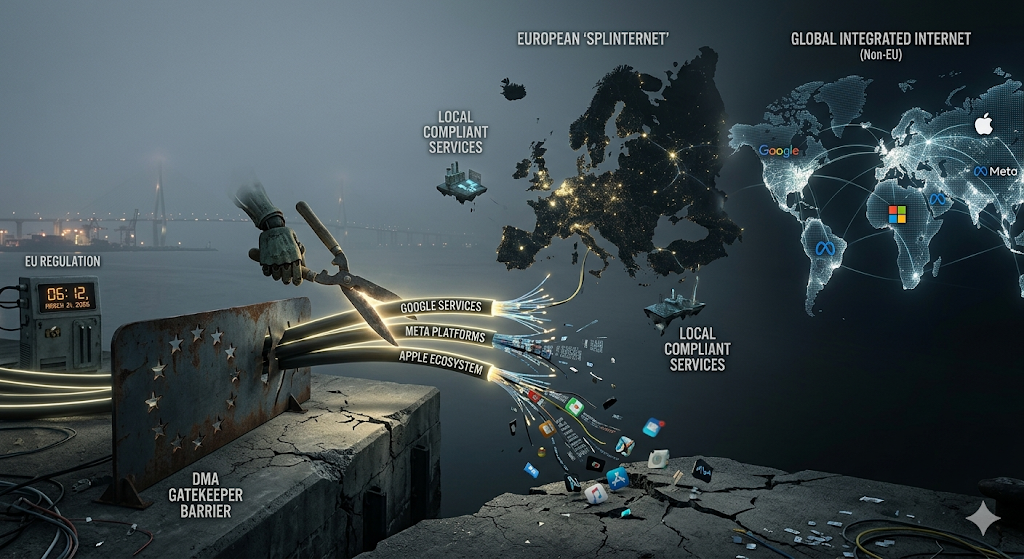
Fragmentation: The New Iron Curtain of the Digital Age
The most damning consequence of the DMA is the rise of the “Splinternet.” By forcing gatekeepers to alter their core products specifically for the European market, the EU is effectively building a digital Iron Curtain. A Google search in Berlin is no longer the same as a Google search in New York or Seoul. An iPhone in Paris is a different product than an iPhone in Tokyo.
This isn’t “digital sovereignty”; it’s digital isolation. I see this not as an empowering move for European consumers, but as a regression. European users are being treated as second-class digital citizens, denied access to the integrated, seamless services that the rest of the world takes for granted, all in the name of an abstract concept of “fairness” that has yet to be defined.
Consider Apple’s forced opening of its App Store ecosystem. The EU calls it “choice.” I call it a security disaster. By mandating sideloading and alternative app stores, the DMA has systematically dismantled the walled garden that protected millions of users from malware, fraud, and data theft. This isn’t competition; it’s an invitation to cybercriminals, with European users as the sacrificial lambs. In an era of hyper-connected 6G where security and resilience have become the ultimate keywords for survival, these regulatory-induced security gaps are no longer mere inconveniences—they risk evolving into systemic national threats.
The Myth of Competition: Regulating Winners, Not Creating Them
The central fallacy of the DMA is the belief that breaking up Big Tech will somehow cause a thousand European startups to bloom. It’s a fairy tale. Real competition comes from innovation, not from regulation that pulls the leader back to the pack. Europe’s problem isn’t that Google is too big; it’s that Europe has failed to create its own Google.
I see this regulatory crusade as a confession of failure. Unable to compete on innovation, Europe has chosen to compete on litigation. The multi-billion euro fines levied against Google and Meta are not trophies of a successful antitrust policy; they are the consolation prizes of a continent that has lost the technology race.
These fines don’t create competition. They don’t fund R&D. They go into the general EU budget, funding the very bureaucracy that is strangling the digital economy. It’s a parasitic relationship, where the regulator feeds on the success of the regulated, all while claiming to be the savior of the consumer.
Conclusion: Who Will Be Left in the Regulatory Wasteland?
The DMA is a grand experiment in regulatory arrogance. It’s an attempt to legislate an ideal market structure into existence, with no regard for the technological realities or the economic consequences. The EU may succeed in punishing Big Tech, but it will be a pyrrhic victory.
The side with the biggest fines will claim victory. The side that has to dismantle its integrated services will retrench. But in this regulatory wasteland, the real loser will be the European consumer, left with a fragmented, less secure, and less innovative digital world.
The dawn fog in Incheon is beginning to lift, revealing the stark, unyielding outlines of the city. As the EU continues its quixotic quest to regulate Big Tech into submission, only one thing is certain: the Internet will never be the same again. The question is, will anyone still want to use it?
Fact Check 3
Prescriptive Regulation Overkill: The DMA imposes rigid, one-size-fits-all prohibitions on “gatekeepers” (such as self-preferencing and data bundling) that stifle the product integration and network effects essential for the seamless digital experiences that define the modern Internet.
Digital Fragmentation: By forcing gatekeepers to create unique product versions for the EU market, the DMA is causing a “Splinternet,” denying European users access to global integrated services and effectively isolating the continent’s digital economy.
Security and Innovation Trade-offs: The DMA’s mandates for interoperability and alternative app stores (like Apple’s forced sideloading) systematically dismantle established security architectures, creating new vulnerabilities for fraud and malware while offering no guarantee of fostering genuine European innovation.
The Sharp Question
If you had to choose between a secure, seamless digital world controlled by a few accountable giants and a chaotic, fragmented regulatory wasteland where “choice” means increased vulnerability and mediocrity, which would you pick?
#EU #DMA #Antitrust #BigTech #Google #Meta #Apple #RegulatoryOverreach #DigitalFragmentation